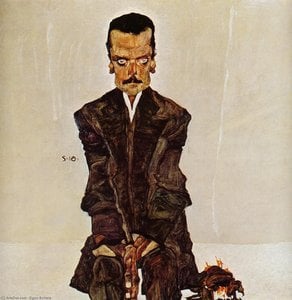
Egon Schiele’s ‘Seated Woman, Back View’: A Study in Fragility and Intensity
Egon Schiele's “Seated Woman, Back View,” painted in 1917, is not merely a portrait; it’s a distilled essence of anxiety, vulnerability, and the unsettling beauty found within human form. Created during a turbulent period in Schiele’s life – a time marked by illness, loss, and an increasingly fraught relationship with his wife, Edith Harms – this watercolor on paper offers a poignant glimpse into the artist's intensely personal world. The work immediately arrests the eye with its muted palette of blues and yellows, colors that simultaneously evoke both melancholy and a subtle, almost feverish energy. Schiele’s signature, delicately placed in the lower right corner, serves as a quiet marker of ownership over this deeply felt image, a testament to his singular vision.
The Composition: A Study in Restrained Movement
What immediately draws attention is the woman's posture – seated, yet profoundly withdrawn. Her back is turned to the viewer, creating an immediate sense of intimacy and exclusion. This deliberate choice forces us to confront her presence not through direct gaze but through suggestion, a technique Schiele frequently employed to amplify emotional impact. The figure’s limbs are drawn upwards, almost as if seeking support or attempting to shield herself from something unseen. The striped shirt and dress, rendered in a restrained palette of blues and yellows, hint at a conventional appearance – a respectable lady – yet the positioning of her lower body, clad in a stark white lace slip and dark stockings, introduces an element of unsettling contrast. This juxtaposition speaks volumes about Schiele’s complex and often contradictory perceptions of femininity, hinting at both admiration and a certain degree of unease.
Expressionism and the Artist's Inner Landscape
Schiele was a pivotal figure in the development of Expressionism, an artistic movement characterized by its subjective emotional expression rather than objective representation. In “Seated Woman, Back View,” this is powerfully evident. The loose brushstrokes, the distorted proportions, and the intense color choices all contribute to a sense of psychological turmoil. The painting isn’t concerned with capturing a realistic likeness; instead, it aims to convey an internal state – a feeling of isolation, perhaps even despair. Schiele's use of watercolor lends itself particularly well to this expressive intent, allowing for delicate gradations of tone and the creation of atmospheric effects that heighten the sense of mood.
Symbolism and the Shadow of Loss
Considering Schiele’s personal life at the time of painting – his father's death from syphilis, the loss of his sister Elvira, and the growing strain within his marriage – it’s not surprising that “Seated Woman, Back View” is imbued with a sense of profound sadness. The woman’s averted gaze can be interpreted as a shield against an unbearable reality. The contrast between her upper body, suggesting respectability, and her lower body, hinting at vulnerability and perhaps even shame, mirrors the complexities of Schiele's own emotional landscape. Some art historians have suggested that the figure represents Edith Harms, reflecting Schiele’s ambivalent feelings towards his wife – a woman he both loved deeply and struggled to fully understand. The painting becomes a visual embodiment of this internal conflict, a poignant meditation on love, loss, and the fragility of human existence.
WahooArt offers meticulously crafted hand-painted reproductions of Egon Schiele’s “Seated Woman, Back View,” allowing you to bring this powerfully evocative artwork into your home or office. Each reproduction is created by skilled artists using traditional techniques, ensuring a faithful and stunning representation of Schiele's original vision. Explore our collection today and experience the raw emotion and enduring beauty of this masterpiece.



 Peržiūrėti realaus dydžio版
 Perjungti į spausdinimą
 Siųsti
 Dalintis
 Išsamiau
 Vadovas

 Atsisiųsti
 Panašūs eksponatai
 Rentgeno spindulių nuotrauka
 Diaporama
 Statistika
 Rodyti daugiau






































 Stiklo variantas prieinamas tik pasirinkus dydį iki 110 cm