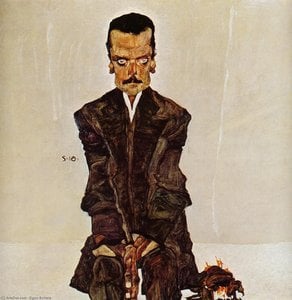
Egon Schiele’s ‘Reclining Woman’: A Study in Vulnerability and Intensity
Egon Schiele's “Reclining Woman,” a haunting black and white sketch, isn’t merely a depiction of a nude figure; it’s a profound exploration of vulnerability, mortality, and the raw, often unsettling, beauty of the human form. Created during a period marked by personal turmoil and artistic experimentation – a time when Schiele wrestled with illness, loss, and his own intensely private world – this work embodies the artist's signature style: a potent blend of expressive realism and psychological depth. The image immediately draws the viewer in with its stark contrasts, the delicate shading emphasizing every curve and contour of the reclining woman’s body. Notice how Schiele masterfully uses line—bold, decisive strokes that simultaneously convey strength and fragility—to sculpt the figure from darkness and shadow. It's a deliberate choice, suggesting both physical presence and an underlying sense of exposure, as if the woman is perpetually on the verge of revealing her innermost self.
Schiele’s technique is characterized by a remarkable economy of line. He avoids superfluous detail, focusing instead on capturing the essence of his subject – its posture, its mood, its very being. The sketch feels remarkably immediate, as if Schiele were working directly onto the paper with little preparation. This immediacy contributes to the work's emotional intensity; it’s a glimpse into a private moment, unvarnished and utterly honest. The composition itself is carefully considered: the woman’s relaxed posture invites the viewer in, while the subtle details – the slight tilt of her head, the delicate curve of her hand – draw attention to her vulnerability. The presence of the two figures in the background adds a layer of complexity, hinting at an unseen narrative and suggesting that this moment of quiet contemplation is not isolated but part of a larger, perhaps troubled, existence.
The Shadow of Mortality: Schiele’s Recurring Themes
Egon Schiele's work is inextricably linked to themes of death, illness, and the fragility of life – subjects deeply influenced by his own personal experiences. His father’s struggle with syphilis cast a long shadow over his childhood, instilling in him a profound awareness of mortality. This preoccupation manifests repeatedly throughout his oeuvre, often expressed through skeletal figures, decaying bodies, and scenes of quiet desperation. “Reclining Woman” is no exception; the woman's posture suggests a certain weariness, a sense of having endured hardship. The sketch’s monochrome palette further reinforces this mood, evoking the stillness of a tomb or the muted tones of a funeral shroud. It’s important to note that Schiele wasn’t simply morbidly fascinated with death; he was attempting to confront it head-on, to grapple with its inevitability and to explore the psychological impact of loss.
Interestingly, Schiele often depicted himself within his own work – frequently as a self-portrait in various states of distress. This self-reflexivity suggests that his art wasn’t merely an external observation but a deeply personal exploration of his own anxieties and vulnerabilities. The presence of the other figures in “Reclining Woman” could be interpreted as reflections of these internal struggles, perhaps representing lost loves or unresolved conflicts. The sketch becomes a microcosm of Schiele's entire artistic vision—a testament to his willingness to confront uncomfortable truths about himself and the human condition.
Expressionism and the Power of Line
“Reclining Woman” is a quintessential example of Expressionist art, characterized by its subjective emotional intensity and distorted forms. Schiele’s use of line—bold, gestural, and often unsettling—is central to this style. He eschewed traditional academic techniques in favor of a more immediate, intuitive approach, prioritizing the expression of feeling over realistic representation. The lines aren't simply outlines; they vibrate with energy, conveying the woman’s physical presence and her emotional state. Notice how the lines thicken and intensify as they converge on certain points of the figure, drawing attention to areas of vulnerability or tension.
Furthermore, Schiele’s choice of black and white—a deliberate rejection of color—contributes significantly to the work's impact. Color, in his hands, becomes secondary to line and form, allowing the viewer to focus on the underlying structure of the image and its emotional resonance. The stark contrast between light and shadow creates a dramatic effect, intensifying the sense of drama and vulnerability. Schiele’s mastery of line is what truly elevates “Reclining Woman” beyond a simple sketch; it transforms it into a powerful expression of human emotion—a testament to the artist's unique vision and his ability to capture the essence of the human experience.
A Timeless Portrait of Human Experience
“Reclining Woman” remains a profoundly moving work, offering a glimpse into the mind of one of art history’s most enigmatic figures. It’s not a comfortable image; it confronts us with our own mortality and our vulnerability. Yet, within its stark simplicity lies a remarkable beauty—a testament to Schiele's ability to capture the essence of human experience with unflinching honesty and profound sensitivity. Reproductions of this sketch offer an opportunity to engage with this powerful artwork on a deeper level, appreciating not only its aesthetic qualities but also the complex emotional landscape that shaped its creation. Consider how the lines, the shadows, and the woman’s posture combine to evoke a sense of both quiet contemplation and underlying tension—a reminder that beauty can often be found in the midst of suffering.



 Peržiūrėti realaus dydžio版
 Perjungti į spausdinimą
 Siųsti
 Dalintis
 Išsamiau
 Gidas
Gidas

 Atsisiųsti
 Panašūs eksponatai
 Rentgeno spindulių nuotrauka
 Diaporama
 Statistika
 Rodyti daugiau






































 Stiklo variantas prieinamas tik pasirinkus dydį iki 110 cm