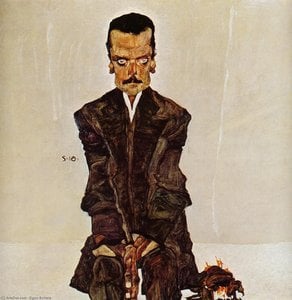
Portrait of Herbert Rainer: A Study in Angular Intensity
Egon Schiele’s “Portrait of Herbert Rainer,” painted in 1910, isn't merely a likeness; it’s a concentrated distillation of the artist’s signature style – a raw, emotionally charged exploration of youth, vulnerability, and the unsettling beauty of the human form. This deceptively simple portrait, rendered primarily in charcoal on paper, immediately draws the viewer into its world of sharp angles and intense gazes, offering a glimpse into Schiele's deeply personal artistic vision. The work’s power lies not in idealized representation but in its unflinching portrayal of a young boy – likely Herbert Rainer, as the title suggests – imbued with an almost palpable sense of contained energy.
The composition itself is subtly arresting. Rather than centering the subject directly, Schiele employs a slight off-center placement, creating a dynamic asymmetry that immediately engages the eye and hints at a restless spirit beneath the surface. The boy’s direct gaze, unwavering and slightly challenging, establishes an immediate connection with the viewer – a feeling of being observed, perhaps even judged. His hands, clasped loosely in his lap, suggest both contemplation and a quiet reserve, adding to the overall sense of contained emotion. The background is deliberately indistinct, serving as a neutral backdrop that amplifies the figure’s presence and directs all attention towards the boy's face and posture.
- Technique: Schiele masterfully utilizes varying line weights – from delicate, almost hesitant strokes to bold, assertive markings – to build form and create tonal variations. This technique is particularly evident in the rendering of the face, where angular lines define the sharp cheekbones and intense brow, while lighter lines suggest subtle shading and modeling.
- Color Palette: The monochromatic palette—primarily shades of gray—further emphasizes the emotional intensity of the portrait. The absence of color forces the viewer to focus on line, texture, and form, amplifying their impact.
- Materials: Executed in charcoal on paper, the work’s surface bears the subtle marks of the artist's hand – a testament to Schiele’s direct and expressive approach. The grainy quality of the paper adds to the portrait’s tactile appeal.
Echoes of Expressionism and Early Modernity
Schiele’s “Portrait of Herbert Rainer” firmly situates itself within the broader context of early 20th-century Expressionism, a movement characterized by its emphasis on subjective experience, emotional intensity, and distortion of form. Influenced by artists like Edvard Munch and Vincent van Gogh, Schiele rejected academic conventions in favor of a more raw and immediate style. The portrait’s angularity, the boy's intense gaze, and the overall sense of unease resonate strongly with the tenets of Expressionism – a deliberate attempt to convey inner turmoil and psychological states through visual means. Furthermore, the work anticipates later developments in modern art, particularly the exploration of the human psyche that would become central to movements like Surrealism.
The portrait’s creation coincided with a period of significant personal upheaval for Schiele—his father's death, his own struggles with illness and loss, and his burgeoning artistic ambitions all contributed to the work’s underlying emotional weight. This biographical context adds another layer of meaning to the image, suggesting that “Portrait of Herbert Rainer” is not simply a depiction of a young boy but also a reflection of Schiele's own anxieties and vulnerabilities.
Historical Context:** The portrait was painted in 1910, a time of rapid social and political change in Europe. The rise of industrialization, urbanization, and new artistic movements were challenging traditional values and beliefs, creating a climate of uncertainty and experimentation. Schiele’s work reflects this broader cultural shift, capturing the anxieties and aspirations of a generation grappling with modernity.
Symbolism and Emotional Resonance
Beyond its technical merits, “Portrait of Herbert Rainer” is rich in symbolic meaning. The boy's angular features—particularly his sharp cheekbones and intense brow—can be interpreted as representing youthful defiance and a rejection of societal norms. His direct gaze suggests a quiet strength and an unwillingness to conform. The portrait’s overall sense of tension and unease reflects Schiele’s fascination with mortality, loss, and the fragility of human existence – themes that would recur throughout his oeuvre.
- Angularity: The prominent use of angular lines creates a feeling of dynamism and restlessness, suggesting an inner turmoil beneath the surface.
- Direct Gaze: The boy’s unwavering gaze challenges the viewer, inviting introspection and prompting questions about identity and self-perception.
- Contained Emotion: Despite the portrait's intensity, there is a sense of restraint—a suggestion that the boy is holding back his emotions, carefully guarding his inner world.
A Timeless Masterpiece
“Portrait of Herbert Rainer” remains a powerfully evocative work of art, demonstrating Schiele’s unparalleled ability to capture the essence of human emotion through line and form. Its raw intensity, combined with its subtle beauty, continues to resonate with viewers today, solidifying its place as one of the artist's most significant achievements. Whether admired for its technical brilliance or its profound emotional depth, this portrait offers a compelling glimpse into the mind of a visionary artist grappling with the complexities of modern life. It’s a piece that invites repeated viewing, revealing new layers of meaning and emotional resonance with each encounter.



 Peržiūrėti realybėje
 Pirkti rankomis tapytą paveikslą
 Pasidalinti
 Dalintis
 Išsamiau

 Atsisiųsti
 Panašūs eksponatai
 Rentgeno nuotrauka
 Automatinė diorama
 Statistika

 Skaityti daugiau






































 Stiklo variantas prieinamas tik pasirinkus dydį iki 110 cm