A Silent Echo of Rural Life: Egon Schiele’s “Landscape with Houses”
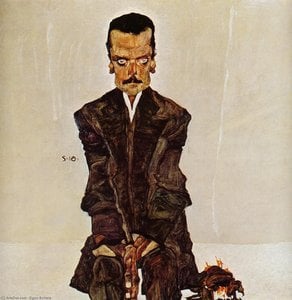
Egon Schiele's "Landscape with Houses," painted in 1917, isn’t merely a depiction of a rural scene; it’s a raw, intensely personal meditation on solitude, mortality, and the quiet dignity of everyday existence. Born amidst the shadowed backdrop of Vienna’s artistic circles and his own deeply troubled family history – marked by illness, loss, and a pervasive sense of unease – Schiele channeled these experiences into a visual language that remains both unsettlingly intimate and profoundly moving. This particular work, rendered in charcoal on paper, offers a glimpse into a world stripped bare of sentimentality, revealing instead the stark beauty and inherent melancholy of the Austrian countryside.
The composition is deceptively simple: a gently rolling landscape punctuated by a cluster of modest houses nestled amongst fields and distant hills. There’s no dramatic sky, no vibrant color to draw the eye – instead, the palette is dominated by shades of gray, white, and cream, creating an atmosphere of muted stillness. Schiele masterfully employs line as his primary tool, using loose, energetic strokes to define shapes and textures. These lines aren't precise or idealized; they’re deliberately fragmented and imperfect, conveying a sense of immediacy and spontaneity – as if the artist were capturing a fleeting impression rather than meticulously recreating a scene. The varying thickness of the lines adds dynamism, suggesting movement within the static image.
The Expressionist Soul: Technique and Style
“Landscape with Houses” firmly establishes Schiele’s place within the burgeoning Expressionist movement. Rejecting the academic traditions of his time, he prioritized emotional intensity over realistic representation. His technique is characterized by a deliberate distortion of form – houses are simplified into geometric blocks, hills flow in undulating curves, and figures (though absent here) would have been rendered with an unsettling lack of anatomical accuracy. This stylistic choice wasn’t intended to be deceptive; rather, it served to amplify the emotional content of the work, forcing the viewer to confront the underlying anxieties and vulnerabilities that Schiele so often explored.
The use of charcoal is particularly significant. Charcoal lends itself beautifully to capturing subtle tonal variations and creating a sense of texture – the rough surface of the paper becomes almost palpable. Schiele’s loose application of the medium contributes to the work's raw, unfinished quality, mirroring the artist’s own turbulent emotional state. It feels as though he was driven by an urgent need to capture a feeling, rather than simply documenting a landscape.
Symbolism and Emotional Resonance
While seemingly straightforward, “Landscape with Houses” is rich in symbolic meaning. The isolated houses evoke a sense of loneliness and vulnerability, reflecting Schiele’s own feelings of alienation and his preoccupation with mortality. The distant mountains, barely discernible on the horizon, represent an unreachable ideal – perhaps a yearning for stability or spiritual solace that remains perpetually out of reach. The absence of human figures further emphasizes this theme of isolation, suggesting a world devoid of connection and companionship.
Schiele’s work frequently grappled with themes of death, illness, and the fragility of life—subjects often veiled in unsettling imagery. This piece is no exception; it carries an undercurrent of melancholy that resonates deeply. The simplicity of the composition allows the viewer to project their own emotions onto the scene, creating a profoundly personal experience.
A Legacy of Intensity: Historical Context and Artistic Influence
Painted during a period of immense social and political upheaval in Europe – just before the outbreak of World War I – “Landscape with Houses” reflects the anxieties and uncertainties of the era. Schiele’s work, along with that of other Expressionist artists, served as a powerful critique of bourgeois values and societal norms. His unflinching portrayal of human suffering and his rejection of conventional beauty challenged established artistic conventions and paved the way for future generations of artists.
Schiele's influence extends far beyond the Expressionist movement. His distinctive style—characterized by distorted forms, intense colors, and a raw emotional honesty—has inspired countless artists across various mediums. Reproductions of “Landscape with Houses” continue to captivate viewers today, offering a window into the mind of one of art history’s most enigmatic and compelling figures.



 Peržiūrėti realaus dydžio版
 Perjungti į spausdinimą
 Siųsti
 Dalintis
 Išsamiau
 Gidas
Gidas

 Atsisiųsti
 Panašūs eksponatai
 Rentgeno spindulių nuotrauka
 Diaporama
 Statistika
 Rodyti daugiau






































 Stiklo variantas prieinamas tik pasirinkus dydį iki 110 cm