An Expressionist Echo of Mortality
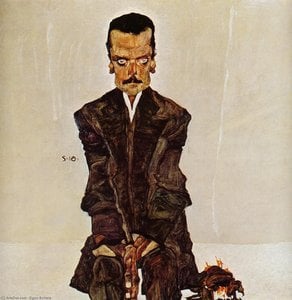
Egon Schiele’s “Composition with Three Male Figures (Self Portrait),” painted in 1911, stands as a cornerstone of Austrian Expressionism and a profoundly unsettling meditation on the human condition. More than just a depiction of the artist himself—a rare self-portrait for Schiele—the painting delves into themes of vulnerability, isolation, and the raw confrontation with death. To gaze upon this work is to enter a psychological landscape where the boundaries between the physical body and the turbulent soul begin to dissolve. The composition presents three men in striking red clothing, arranged in a dynamic, almost precarious stack, with one figure positioned atop the others. This arrangement creates an immediate sense of tension, drawing the viewer into a scene that feels both deeply personal and universally haunting.
The technical mastery of Schiele is evident in his departure from the soft, light-filled nuances of Impressionism toward a much more visceral approach. His style is immediately recognizable through its bold simplification of form and a heavy application of impasto. This thick, textured surface allows the paint to physically protrude from the canvas, lending a palpable weight to the figures' presence. Schiele employs vibrant, aggressive reds that dominate the palette, creating a striking visual impact that demands attention. The angular, often jagged poses of the subjects contribute to an overall sense of unease and movement, mirroring the artist’s own preoccupation with psychological intensity and the nervous energy of the modern era.
Symbolism and the Weight of Existence
Within this masterpiece, color serves as a profound symbolic language rather than mere decoration. The dominant red hue is particularly potent; it acts as a multifaceted symbol representing passion and desire, yet it simultaneously evokes the imagery of blood—a stark and inescapable reminder of mortality and decay. This duality is central to Schiele’s vision, where beauty and anguish are inextricably intertwined. While the figures are rendered with meticulous attention to detail, their facial expressions convey profound sadness and apprehension, inviting the observer to contemplate the fragility of life itself.
The historical context of the piece further enriches its meaning. Created during a period of intense artistic experimentation and intellectual ferment in Vienna, the work reflects the broader anxieties of the burgeoning modernist movement. Schiele’s vision was undoubtedly shaped by the Symbolist pioneers such as Edvard Munch and Odilon Redon, whose explorations of psychological states paved the way for his Expressionist aesthetic. For the discerning collector or interior designer, this painting offers more than just a visual centerpiece; it provides a window into an era of profound discovery, making it an ideal acquisition for those looking to infuse a space with intellectual depth and emotional resonance.
A Timeless Addition to the Modern Interior
For those seeking to curate a collection that speaks to the complexities of human emotion, a high-quality reproduction of this work offers an unparalleled opportunity. The painting’s bold color palette and dramatic composition make it a versatile choice for sophisticated interiors, capable of anchoring a room with its commanding presence. Whether placed in a contemporary gallery setting or a more traditional study, the piece serves as a conversation starter, prompting reflections on the enduring power of Expressionism.
Owning a reproduction of Schiele’s work allows one to live alongside the "unvarnished pulse of the human soul." It is an invitation to witness the tremors of anxiety and the beauty of existence every day. As a piece of art, it does not merely decorate a wall; it transforms a space into a sanctuary for contemplation, much like the legendary museums that house Schiele's original treasures.



 Peržiūrėti realaus dydžio版
 Perjungti į spausdinimą
 Siųsti
 Dalintis
 Išsamiau
 Gidas
Gidas

 Atsisiųsti
 Panašūs eksponatai
 Rentgeno spindulių nuotrauka
 Diaporama
 Statistika

 Rodyti daugiau






































 Stiklo variantas prieinamas tik pasirinkus dydį iki 110 cm