A Somber Symphony in Monochrome
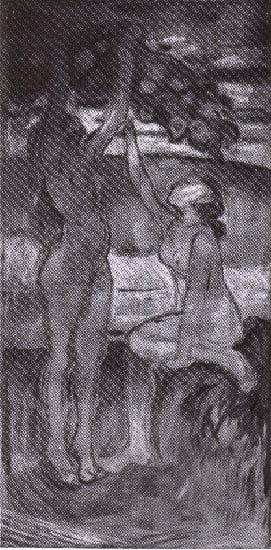
In the quiet, evocative depths of Edvard Munch's 1909 masterpiece, "Harvest," we encounter a world where the boundaries between the physical landscape and the human psyche begin to dissolve. This striking black and white canvas serves as more than a mere depiction of a pastoral moment; it is a profound meditation on the cyclical nature of life, loss, and the enduring embrace of the natural world. As an exemplar of Expressionism, the painting eschews the objective clarity of realism to instead prioritize the visceral, emotional truth of the scene. Through a deliberate use of tonal variation and gestural brushwork, Munch invites the viewer into a space of quiet contemplation, where the rustle of leaves and the stillness of the figures suggest a moment suspended in time.
The composition is masterfully centered around two female figures positioned within a grove of trees. There is an intimate, almost voyeuristic quality to their placement, as if we have stumbled upon a private vigil. Munch employs a flattened perspective that heightens this sense of intimacy, bringing the background foliage into a closer, more pressing relationship with the subjects. The trees themselves, rendered with loose and spontaneous lines, reach upward like skeletal fingers, partially obscuring the sky and creating a sense of enclosure. This lack of rigid geometric structure allows for a dynamic portrayal of movement, where the organic shapes of the women's forms blend seamlessly into the irregular, textured contours of the landscape.
The Texture of Memory and Grief
To behold "Harvest" is to feel the weight of Munch’s personal history. The artist’s life was profoundly shaped by the shadows of mortality, specifically the premature deaths of his mother and sister from tuberculosis. These early traumas infused his work with a haunting preoccupation with grief and the fragility of existence. In this piece, the monochromatic palette—a spectrum of somber grays and deep blacks—acts as a visual echo of such sorrow. The absence of vibrant color strips away any superficial distractions, forcing the eye to focus on the impasto technique, where thick, layered applications of paint create a rugged, tactile surface. This textural richness mirrors the weathered landscape, suggesting that even in decay, there is a profound, textured beauty.
For the discerning collector or interior designer, "Harvest" offers an unparalleled emotional depth that can anchor a room with its quiet intensity. The painting does not demand attention through loud colors but commands it through atmospheric resonance. It functions as a window into the soul of Expressionism, making it an ideal centerpiece for spaces designed for reflection and intellectual engagement. Whether viewed as a study in light and shadow or as a symbolic narrative of life's fleeting nature, the artwork provides a sophisticated layer of storytelling to any curated collection.
Ultimately, Munch’s "Harvest" remains a timeless exploration of the human condition. It captures the tension between the vulnerability of the individual and the indomitable strength of nature. By embracing imperfection through his gestural strokes and avoiding the trap of photographic precision, Munch achieves a level of emotional resonance that continues to captivate modern audiences. It is a piece that does not merely sit upon a wall; it breathes with the heavy, beautiful rhythm of memory and the eternal cycle of the earth.
问答 (or more naturally for a website heading): Klausimai ir atsakymai
Ar „Harvest“, autorius – Edvardas Munkas vaizdą galima laisvai reprodukcijaoti?
Kalbant apie autorišką teisę, „Harvest“ yra pripa принадле belongs to the public domain – jo autorinė teisė pasibaigusi.
Kaip rasti panašių kūrinių kaip „Harvest“, autorius – Edvardas Munkas?
Puslapio Panašūs kūriniai skiltyje, skirtoje kūriniam darbui „Harvest“, autorius – Edvardas Munkas, pateikiami panašūs meno kūriniai.
Kaip medžiaga ir judėjimas susilieja darbe „Harvest“?
„Harvest“, autorius – Edvardas Munkas sujungia Oil On Canvas techniką su Expressionism stiliumi. Technika ir stilius apibūdina kūrinio gamybos būdą bei estetinį iš Ausdrucką.
Ar „Harvest“ galima peržiūrėti papildydami realybę?
„Harvest“, autorius – Edvardas Munkas puslapio AR peržiūra naudojasi papildytoji realybe, kad suderinamame įrenginyje parodytų kūrinį jūsų erdvėje.
Ar „Harvest“, autorius – Edvardas Munkas yra paveikslas, piešinys ar grafika?
„Harvest“ yra WallArt kūrinys.
Kokio ryškumo spalvos turi „Harvest“, autorius – Edvardas Munkas?
Šiame paveikslėlyje „„Harvest“, autorius – Edvardas Munkas“ spalvų intensyvumas yra Monochromatic.
Kokia spalvų intensyvumas pasižymi „Harvest“, autorius – Edvardas Munkas?
„Harvest“, autorius – Edvardas Munkas spalvų nasyginimas yra Muted. Nasyginimas apibūdina, kokių spalvos yra ryškių arba išblukusių.
Kur galiu įsigyti „Harvest“, autorius – Edvardas Munkas spausdinį?
Norėdami užsisakyti „Harvest“, autorius – Edvardas Munkas spausdinį, tiesiog jį užsisakykite ši ši puslapį: aukščiausios kokybės spausdinys ant medžio siuvinėjamų audinių arba archyvinio kanvas tipo popieriaus.


 Peržiūrėti realaus dydžio版
 Perjungti į spausdinimą
 Siųsti
 Dalintis
 Išsamiau
 Vadovas

 Atsisiųsti
 Panašūs eksponatai
 Rentgeno spindulių nuotrauka
 Diaporama
 Statistika

 Rodyti daugiau






































 Stiklo variantas prieinamas tik pasirinkus dydį iki 110 cm


