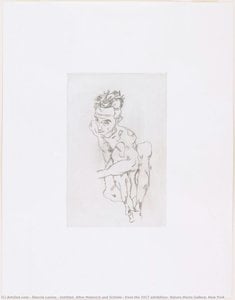
The Echoes of Academia: Capturing Benchers Hall
To stand before this charcoal rendering of Benchers Hall within the Inner Temple is not merely to observe an architectural facade; it is to step into a moment suspended between rigorous structure and profound introspection. David Bomberg, in this evocative work from 1947, has achieved something far more elusive than mere documentation. He has captured the very atmosphere—the weighty, scholarly breath—of these ancient halls. The subject matter, undeniably architectural, serves as a vessel for his deeply personal vision. One can almost hear the hushed tones of debate and the rustle of centuries-old parchment echoing off the stone walls depicted.
A Masterclass in Expressive Line and Tone
Technically, this piece is a breathtaking study executed in charcoal on paper. Bomberg’s handling of the medium is nothing short of masterful. The monochromatic palette—a rich interplay of blacks, grays, and whites—allows the texture of the charcoal itself to become a primary artistic element. Observe how he uses hatching and cross-hatching; these are not just shading techniques but dynamic lines that build form from suggestion rather than solid outline. While the underlying geometry of the arches and windows suggests classical order, Bomberg’s line quality refuses to be purely academic. It possesses a restless energy, a loose sketchiness juxtaposed against firm structural definitions, giving the entire composition a vibrant, almost vibrating life force.
Compositional Depth Beyond Representation
The way Bomberg structures the scene is particularly compelling. The strong horizontal sweep of the hall anchors the piece, yet this stability is countered by diagonal recession suggested by the pathway leading into the depth. He manipulates perspective with an intuitive grace; it is not a photographically perfect view, but rather an emotionally calibrated one. This deliberate fragmentation—the way elements seem slightly abstracted or viewed from an unusual angle—is key to its power. It forces the viewer’s eye to wander, searching for coherence within the expressive chaos, mirroring the intellectual process of deep study itself.
Symbolism and the Weight of Time
Given the date, 1947, this work carries an undeniable resonance with the post-war spirit. The somewhat melancholic, diffused lighting and the fragmented nature of the depiction can be read as a reflection on disruption—the sense that even the most enduring institutions must pass through periods of questioning or change. Bomberg transcends the role of chronicler; he becomes interpreter. The Inner Temple, usually symbols of immutable law and tradition, are rendered with an underlying current of introspection, suggesting that true permanence lies not in stone, but in the ideas nurtured within those walls.
Bringing the Atmosphere Home
For collectors or designers seeking art that speaks to history, intellect, or quiet contemplation, this reproduction offers unparalleled depth. It is a piece that rewards close looking; one might spend hours tracing the interplay of shadow and line, discovering new textures in the charcoal as the light shifts. Owning this work means curating not just an object for a space, but an enduring mood—a sophisticated echo of academic grandeur tempered by the raw, passionate energy of modern expressionism.



 Peržiūrėti realybėje
 Perejti prie spausdinimo
 Pasidalinti
 Dalintis
 Išsamiau

 Atsisiųsti
 Panašūs eksponatai
 Rentgeno nuotrauka
 Automatinė diorama
 Statistika


 Skaityti daugiau