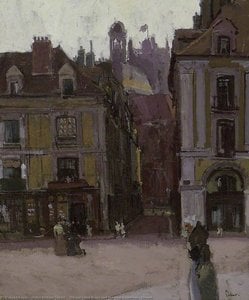
Impressionism
 71.0 x 82.0 cm
Įsigykite aukštos skiriamosios raiškos, patobulintą skaitmeninį vaizdą, gerokai pranašesnį už internetinę peržiūrą.
Kiekvieną failą mūsų specialistai kruopščiai paruošia naudojant pažangias technologijas ir profesionalų rankinį retušavimą. Užtikriname, kad kiekvienas vaizdas pasižymėtų išskirtiniu aiškumu, tikslia spalvų atspalviu ir smulkiomis detalėmis.
Baigiamas failas el. paštu pristatomas per 72 valandas; jis optimizuotas nedelsiant naudojimui profesionalioje, redakcinėje ir spausdinimo aplinkoje. Tai ta pati kokybė, kuria pasitiki aukščiausios klasės dizaino studijos, leidyklos ir galerijos.
Atsisiųskite didelės raiškos failą asmeniniam naudojimui, spausdinimui ir kūrybiniams projektams. ( Pirkti spaudinį Pirkti rankomis tapytą paveikslą)
Pasirinkę WahooArt.com, jūs ne tik gaunate paveikslėlį – jūs gaunate profesionaliai patobudintą skaitmeninį kūrinį, sukurtą itin tikniai ir užtikrinantį pasitenkinimą. Štai viską, kas automatiškai pritékia jūsų užsakymui:

Jūsų aukštos raiškos skaitmeninis vaizdo failas bus išsiųstas jums el. paštu per 72 valaudas nuo užsakymo – paruoštas naudojimui be jokių papildomų veiksmų.

Jūsų meno kūrinys profesionaliai optimizuojamas naudojant pažangius dirbtinio intelekto įrankius ir rankinį redagavimą, užtikrinant maksimalią detalę, aiškumą ir spalvų tikslumą.

Atsitiktinai ištrytikote ar praradote savo failą? Nebijokite – bet kuriuo metu atsiųsime jį jums vėl nemokamai.

Mėgaukitės savo meno kūriniu akimirka – skaitiniai failai visada yra neapmokestinami, todėl nereikės mokėti muitinės, mokesčių ar pristatymo mokesčių.

Naudodami profesionalią įrangą ir spalvų valdymo sistemas, užtikriname, kad jūsų skaitmeninis vaizdas kuo tiksliau atspindėtų originalias spalvas.

Jei nebuvate patenkinti savo skaitinio vaizdo, per 100 dienų jį pertaisysime arba grąkinsime 100% sumą – be jokių klausimų.

Nepat 만족inti? Gaukite visą sumokėtą sumą per 100 dienų nuo skaitmeninio failo gavimo – be jokių papildomų klausimų.

Pirkti 3 nuotraukas – pasiūla 10% - Pirkti 5 – pasiūla 15% - Pirkti 10 ir daugiau – pasiūla 20%. Puikiai tinka kūrybiniams projektams, galerijoms bei agentūroms.

Born in the heart of Wandsworth, London, in 1904, Clifford Eric Martin Hall emerged as a painter whose brush captured the shifting textures of twentieth-century urban life and the profound mysteries of the human form. His early years, spent navigating the streets of Richmond and Sheen Avenue, provided the foundational imagery for a career that would oscillate between the gritty realism of London’s bohemian quarters and a deeply introselctive, almost surrealist exploration of identity. Educated through a rigorous classical lineage—from Richmond Hill School to the prestigious Royal Academy Schools under a Landseer scholarship—Hall possessed a technical mastery that allowed him to move seamlessly from the precise demands of portrait commissions to the atmospheric vagueness of street scenes.
The trajectory of Hall’s artistry was profoundly shaped by his time in Paris during the late 1920s. Living and working in the vibrant Montparnasse district, he studied under the influential André Lhote, an experience that infused his British sensibilities with a Continental modernism. This period of international exposure, shared alongside contemporaries like Edwin John, allowed him to absorb the avant-garde spirit of the era. Upon his return to England in the 1930s, Hall became a chronicler of the London zeitgeist, finding inspiration in the bustling, often shadowed corners of Soho. His work during this time reflected the influence of masters such as Walter Sickert and Charles Sims, blending a keen observational eye with a moody, atmospheric approach to light and shadow.
The Second World War brought a somber shift to Hall’s creative output. Serving in a stretcher party near Lots Road, he witnessed firsthand the devastation of the Blitz. This period of upheaval left an indelible mark on his psyche; his drawings from this era, which document the harrowing effects of air raids, are now preserved within the Imperial War Museum, serving as vital historical testimonies to London's resilience. Yet, even amidst the chaos of conflict, Hall’s fascination with the human figure remained a constant, though it would soon undergo a radical and haunting transformation.
In the twilight of his career, specifically from the mid-1960s onwards, Hall achieved his most distinctive and enigmatic stylistic evolution. Moving away from the conventional full-face portraits of his youth, he began to paint women swathed in heavy fabrics, towels, or drapery that obscured their features almost entirely. This late period was characterized by a sense of profound mystery; whether it was a woman facing away from the spectator or a figure hidden behind a veil of cloth, the face—the traditional seat of identity—was intentionally withheld. These works created a powerful tension between presence and absence, inviting the viewer to contemplate what lies beneath the surface.
The legacy of Clifford Hall is defined by this duality: he was both a documentarian of a vanishing London and a pioneer of an introspective, obscured portraiture. His ability to weave together the following elements makes his body of work uniquely significant:
Today, Hall is remembered not merely as a painter of scenes, but as an artist who understood that what is hidden can often be more evocative than what is revealed. His canvases remain windows into a lost era of London life, draped in the beautiful, haunting shadows of his own making.

1904 - 1973 , United Kingdom

 Peržiūrėti realybėje
 Pasidalinti
 Dalintis
 Išsamiau

 Atsisiųsti
 Panašūs eksponatai
 Rentgeno nuotrauka
 Automatinė diorama
 Skaityti daugiau