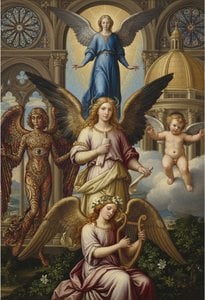
St Maurice and the Angel – A Venetian Baroque Masterpiece
Bernardo Strozzi’s “St Maurice and the Angel,” painted in 1635, stands as a testament to the flourishing artistic spirit of Venice during its Golden Age. This monumental canvas embodies the baroque style's dramatic flair and masterful use of color—a visual feast that continues to captivate viewers centuries later.
Subject Matter & Narrative
The painting depicts Saint Maurice, a Roman soldier revered for his unwavering faith and leadership, accompanied by an angelic figure. Tradition recounts that Maurice rallied a legion of soldiers who refused to participate in pagan rituals during Diocletian’s persecution of Christians. The scene portrays them standing before what appears to be a fortified wall—likely symbolizing the protection afforded by divine grace amidst adversity.
Style & Technique – Venetian Baroque at Its Finest
Strozzi's approach aligns perfectly with the Venetian baroque tradition, championed by artists like Titian and Tintoretto. He employs a rich palette of luminous colors—deep reds, blues, and golds—creating an atmosphere of palpable emotion. The brushstrokes are broad and energetic, conveying movement and dynamism while simultaneously achieving remarkable textural detail. Strozzi’s meticulous attention to light and shadow contributes significantly to the painting's dramatic impact.
Historical Context & Patronage
Venice in the mid-17th century was a hub of artistic innovation and papal patronage. Francesco Erizzo, the Doge (ruler) at the time, commissioned Strozzi’s “St Maurice and the Angel,” recognizing his exceptional talent and aligning with the Venetian elite's desire to adorn their palaces and churches with masterpieces reflecting spiritual contemplation.
Symbolism & Emotional Resonance
The angel represents divine guidance and purity—a counterpoint to Maurice’s earthly strength. The fortified wall symbolizes resilience and faith, emphasizing the saints’ unwavering devotion in the face of persecution. Strozzi's masterful depiction captures not only a biblical narrative but also the profound emotional depth characteristic of baroque art: courage, piety, and hope for salvation.
Location & Reproduction
"St Maurice and the Angel" resides in the Hermitage Museum in Saint Petersburg, Russia—a testament to its enduring artistic significance. High-quality reproductions are available from WahooArt.com offering collectors and interior designers alike a chance to experience this iconic artwork firsthand.



 Peržiūrėti realaus dydžio版
 Perjungti į spausdinimą
 Siųsti
 Dalintis
 Išsamiau
 Gidas
Gidas

 Atsisiųsti
 Panašūs eksponatai
 Rentgeno spindulių nuotrauka
 Diaporama
 Statistika


 Rodyti daugiau






































 Stiklo variantas prieinamas tik pasirinkus dydį iki 110 cm