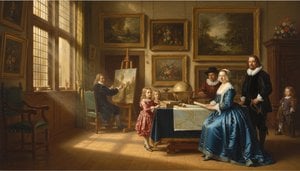
The Quiet Genius of Dutch Still Life
In the golden light of the seventeenth-century Netherlands, a period defined by maritime prosperity and an unprecedented flourishing of culture, there emerged a painter whose work captured the very essence of domestic tranquility. Barent Vermeer (1659–1702), often whispered in the same breath as the legendary Johannes Vermeer, remains one of the most enigmatic figures of the Dutch Golden Age. Born in Haarlem around 1659, his life was characterized by a remarkable lack of drama; he lived the steady, unassuming life of a husband and father navigating the daily rhythms of Delft. Yet, beneath this veneer of ordinary existence lay an extraordinary artistic vision that transformed the mundane into the monumental.
Vermeer’s artistic evolution began under the watchful eye of his father, Jan Vermeer van Haarlem the Elder, a landscape painter who provided him with a rigorous foundation in perspective and the subtle gradations of tone. However, the young artist was not content to merely replicate the horizons of his father's work. He possessed a revolutionary instinct for capturing the ephemeral—the way light dances across a surface or how atmosphere settles within a room. By the time he joined the Haarlem Guild of St. Luke in 1681, he had established himself as a professional force, capable of translating the textures of reality into luminous oil paintings that breathed with life.
A Mastery of Light and Texture
The true brilliance of Barent Vermeer lies in his unparalleled sensitivity to detail. While many of his contemporaries sought grandeur through mythological or religious narratives, Vermeer found divinity in the small, the tactile, and the everyday. His compositions are masterclasses in chiaroscuro and atmospheric depth, heavily influenced by the dramatic lighting effects of Willem Kalf. He absorbed elements of maritime painting to infuse his still lifes with a sense of weight and presence, making every object feel as though it occupied a tangible space within the viewer's own world.
To gaze upon a Vermeer still life is to experience a profound intimacy. His brushwork meticulously rendered:
- The delicate, translucent folds of fine fabrics and linens.
- The glistening, dew-kissed surfaces of ripe fruit and seasonal vegetables.
- The soft, diffused glow of light filtering through a window into a quiet interior.
- The heavy, reflective sheen of pewter and silver vessels.
This dedication to realism allowed him to elevate simple subjects—a bowl of fruit, a musical instrument, or a domestic arrangement—into profound meditations on existence. His work does not merely show us objects; it invites us to feel the temperature of the room and the stillness of the moment.
Legacy of the Dutch Golden Age
Though his life ended prematurely around 1702, Vermeer’s contribution to the Dutch canon remains indelible. He was a vital part of a movement that turned the collective eye of the Netherlands inward, celebrating the prosperity and quiet dignity of the burgeoning middle class. His ability to marry the technical precision of the Haarlem tradition with the atmospheric soul of Delft created a legacy that continues to captivate modern audiences.
Today, his works serve as a window into a vanished era of peace and meticulous craftsmanship. Through his eyes, we see the 17th century not as a distant historical period, but as a living, breathing world of light and shadow, where even the simplest object holds the potential for eternal beauty. His influence persists in the way we perceive the interplay between reality and art, reminding us that there is profound magic to be found in the quietest corners of our lives.



 Peržiūrėti realybėje
 Pirkti spaudinį
 Pasidalinti
 Dalintis
 Išsamiau

 Atsisiųsti
 Panašūs eksponatai
 Rentgeno nuotrauka
 Automatinė diorama

 Skaityti daugiau






































 Stiklo variantas prieinamas tik pasirinkus dydį iki 110 cm