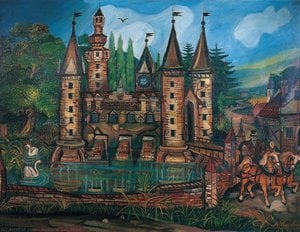
Šiame puslapyje rodomas meno kūrinys yra saugomas autorių teisių įstatymais, todėl neturime teisės legaliai kurti ar parduoti jo identiškos reprodukcijos. Ši apsauga užtikrinama remiantis tokiais tarptautiniais susitarimais kaip Bernės konvencija ir pagal nacionalines įstatymų nuostatas, įskaitant tas, kurias nurodo JAV autoriškos teisės įstatymas – 17-asis skyrius.
Šis metodas visiškai atitinka autorių teises, nes jame nėra saugomo kūrinio kopijavimo ar dubliavimo. Tai yra kūrybinė reinterpretacija – naujas paveikslas, kurį įkvėpė originalas, tačiau kuris nėra jo identiškas.
Muziejų lygio „giclée“ arba drobos spausdinimas: greita gamyba ir lankstios apdailos parinktys. ( Pirkti rankų darbo tapybą Perejti prie skaitmeninių vaizdų)





























Pasirinkite iš mūsų nustatytų dydžių, atitinkančių originalaus meno kūrinio proporcijas.

Įveskite jums reikiamą plotį ir aukštį, kad atvaizdas derėtų prie jūsų rėmo ar sienos. Spausdiną galima tik sumažinti, bet nepadidinti virš originalaus paveikslėlio dydžio, todėl keičiant proporcijas, dalis vaizdo prarandama. Prieš spausdinimą atsiųsime jums skaitmeninį maketą patvirtinimui. Šioje puslapio nuotraukoje matomas pjūvis nėra tikslus – jį rodo tik maketas.
Pristatymas visame pasaulyje () per 2 weeks, o ne įprastas 4/5 savaičių laikotarpis. (15 lapkritis)
Self-portrait
Reprodukcijos matmenys
In the quiet, profound depths of Antonio Laccabue’s Self-portrait (1951), we encounter more than just a likeness; we meet a man navigating the complex intersections of identity and existence. This evocative piece serves as a hauntingly beautiful testament to the artist's ability to blend the raw, unvarnished reality of his own life with a dreamlike, almost surrealist landscape. The subject is presented in a half-length pose, captured with a photographic stillness that commands immediate attention. Clad in a jacket fastened at the chest and a light, checked handkerchief knotted around his neck, Laccabue presents himself with an extreme dignity that belies the underlying vulnerability visible in his features. His face, clean-shaven yet strongly hollowed, carries the weight of a life marked by profound personal tragedy, including the loss of much of his family during his youth. The subtle presence of a hematoma at the right temple adds a layer of physical and psychological mystery, inviting the viewer to wonder about the unseen struggles that shaped this resilient spirit.
The composition of the painting is a masterclass in dualistic storytelling, where the intimacy of the portrait meets the expansive, symbolic breadth of the natural world. Laccabue divides his canvas into two distinct atmospheric realms. To the left, a tranquil yet melancholic marsh unfolds, where delicate grasses sway and a large dragonfly is silhouetted against the sky—a symbol of transformation and the fleeting nature of life. To the right, the scene shifts toward a more vibrant, pastoral vitality; cornfields stretch toward the horizon, dotted with bright poppies and the watchful, lonely presence of a scarecrow. This juxtaposition between the stillness of the marsh and the life-filled fields creates a rhythmic tension, mirroring the artist's own internal struggle between isolation and his deep connection to the earth.
Technically, this work exemplifies the unique charm of Laccabue’s style, often categorized within the tradition of Naïve art but elevated by a sophisticated use of color and light. The artist employs a vivid palette that breathes life into the background, where birds take flight against a sky that feels both vast and intimate. His technique allows for a remarkable clarity in detail—from the texture of the clothing to the delicate wings of the dragonfly—ensuring that every element contributes to the painting's emotional resonance. For collectors and interior designers alike, this reproduction offers a profound focal point for any curated space. It is not merely a decoration but an invitation to contemplation, bringing a sense of historical depth, narrative complexity, and a soulful, quiet energy into a modern home or gallery setting.
Originalus kūrinys „Self-portrait“ – Antonio Laccabue – tai Oil darbas, kurio matmenys yra 72 x 51 cm. Technika ir dydis aprašo originalų objektą.
Darbai, panašūs į „Self-portrait“, pateikiami kūrinio Panašūs kūriniai puslapyje.
„Self-portrait“ galima įsigyti kaip rankomis dažyta aliejaus reprodukcija ant lininio drobos. Užsakymą galite padaryti specialioje Rankų darbo aliejinis reprodukcija puslapio, pasirinkę tinkamą dydį.


1899 - 1965 , Šveicarija

Explore 25 iconic Rococo masterpieces by Jean-Antoine Watteau. Discover the full collection online at WahooArt.com.

Explore the evolution of identity from Dürer to Tschabalala Self through expert analysis. Trace the history of the gaze with us.

Explore the profound psychological depth of master portraiture through expert analysis. Discover the true essence of the human spirit today.

Immerse yourself in the tranquil beauty of Jean-Baptiste-Camille Corot. Explore 25 iconic landscapes that defined the Barbizon school through light and atmosphere. Find inspiration for museum-quality art reproductions and decor. Discover all masterpieces on WahooArt.com.

Explore 25 iconic Modigliani masterpieces and their soulful stories. Discover the full collection online at WahooArt.com.
 Peržiūrėti realaus dydžio版
 Pasidalinti
 Dalintis
 Išsamiau
 Vadovas

 Atsisiųsti
 Panašūs eksponatai
 Rentgeno spindulių nuotrauka
 Automatinė diorama
 问答
问答
 Statistika


 Skaityti daugiau









 Stiklo variantas prieinamas tik pasirinkus dydį iki 110 cm