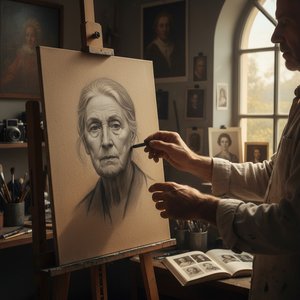
A life shaped by the sea and the brush
Before he ever held a brush in a London studio, Samuel Drummond knew the rhythm of the Baltic trade routes. At thirteen, his world was defined by the salt and wood of ships, spending six or seven years in the sea service. This early time on the water left its mark on his later work, where the movement of waves and the weight of naval history became central themes. After leaving the navy, he worked briefly as a clerk, but the pull of the Royal Academy Schools in 1791 eventually led him away from ledgers and back to the visual arts.
His training began with crayons and oil, a path that saw him exhibit over three hundred works at the Royal Academy. He moved through the ranks of the artistic community, becoming an associate of both the Royal Academy and the British Institution by 1808. His hands were accustomed to the precision required for portraits, yet he found a particular gravity in larger oil paintings that documented the maritime history of the United Kingdom.
The faces and the waves
Drummond had a way of rendering a likeness with speed, a quality that brought him frequent commissions. He sat many notable figures before him, capturing the presence of people such as Walter Scott, Elizabeth Fry, and Marc Isambard Brunel. His work for The European Magazine under James Asperne allowed him to document the leading personalities of the day, including Sir John Soane and Friedrich Accum. In these portraits, one can see a focus on the textures of clothing—the crispness of a white collar or the heavy drape of a coat—and the steady gaze of the sitter.
Beyond the individual portrait, his attention turned to the sea. He used oil on canvas to capture the chaos and weight of naval conflict. His paintings often focused on specific historical moments, such as:
- The Battle of the Nile, 1st August 1798
- Captain William Rogers Capturing the Jeune Richard, 1 October 1807
- Admiral Duncan at the Battle of Camperdown, 11 October 1797
- The Death of Nelson
In these maritime scenes, the brushwork carries the energy of a naval clash. He documented the death of Admiral Horatio Nelson through several works, including a scene on the deck of HMS Victory, where the focus remains on the gathered crowd and the heavy atmosphere of the moment.
A family of artists
The practice of painting was a shared language within his household. Drummond’s life was marked by three marriages, and the creative impulse seemed to pass directly to his children. His daughters, including Rose Emma, Ellen, Eliza Ann, Jane, Rose Hudson, and Rosa Myra, all became artists themselves. Rose Emma, in particular, found her own way as a portrait miniaturist, known for her depictions of theatre actresses.
Despite the professional success of his children and his own standing within the Royal Academy, the later years brought financial difficulties. He often relied on support from the funds of the Royal Academy to sustain his craft until his death in London in 1844. His legacy remains held in collections such as the National Portrait Gallery, the National Maritime Museum, and the Walker Art Gallery.
Q&A
Samuel Drummond의 작품을 기법별로 모아볼 수 있는 곳은 어디인가요?
특정 매체로 제작된 Samuel Drummond의 모든 작품을 확인하시려면, 작가의 모든 매체별 페이지를 이용해 주세요.
Samuel Drummond 작가의 작품 관련 통계 정보는 어디에서 확인할 수 있나요?
Samuel Drummond 작가의 작품 통계 정보는 방문 통계 페이지에서 확인하실 수 있습니다.
Samuel Drummond가 그린 모든 주제를 한눈에 볼 수 있는 개요가 있나요?
Samuel Drummond의 작품은 작가의 주제별 작품 모음 페이지에서 주제별로 찾아보실 수 있습니다.