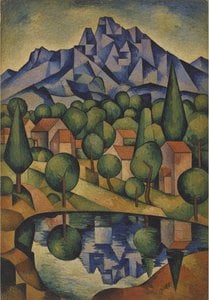
A Vision of Geometric Harmony: Exploring Cézanne’s “Self Portrait 1”
Paul Cézanne's "Self Portrait 1," painted circa 1867-1868, stands as a pivotal work in the transition from Impressionism to Cubism—a testament to Cézanne’s unwavering pursuit of artistic innovation and his profound influence on subsequent generations of artists. Initially dismissed by critics who favored the fleeting beauty of Impressionistic landscapes, Cézanne persevered, driven by an internal conviction that art should strive for a more enduring representation of reality than mere optical sensation. This conviction manifested itself in a radical reworking of traditional portraiture, prioritizing structure and form over meticulous detail—a stylistic shift that would irrevocably reshape the visual language of modern art.
- Subject Matter: The painting depicts Cézanne himself seated before a boat, gazing directly at the viewer with an expression of quiet contemplation. His gaze is unwavering, conveying both vulnerability and intellectual curiosity – qualities that resonate deeply within the viewer’s experience.
- Style & Technique: Cézanne's approach defies easy categorization. While undeniably rooted in Impressionistic observation—evident in the subtle gradations of color—the composition abandons Impressionism’s emphasis on atmospheric haze for a deliberate simplification of form. Geometric shapes dominate the canvas, particularly cubes and cylinders, which are rendered with painstaking accuracy despite their apparent solidity. Cézanne employs thick impasto brushstrokes, layering pigment onto the surface to create palpable texture and emphasizing volume.
Historical Context & Artistic Influences
Cézanne’s artistic trajectory unfolded against a backdrop of burgeoning intellectual ferment in Paris during the Belle Époque. The Impressionists had championed a revolutionary aesthetic, rejecting academic conventions and prioritizing subjective perception. However, Cézanne recognized that Impressionism's limitations lay in its inability to capture the essence of objects—their underlying structure and permanence. He drew inspiration from Japanese prints (ukiyo-e), which favored flattened perspectives and stylized representations of nature – techniques that challenged Western artistic traditions. Furthermore, Cézanne’s explorations into geology and mathematics informed his compositional decisions, reflecting a broader interest in scientific observation and geometric principles.
Symbolism & Emotional Resonance
Beyond its formal innovations, “Self Portrait 1” possesses a subtle symbolic depth. The boat serves as a visual anchor, grounding Cézanne’s figure within the natural world—a deliberate gesture that underscores his belief in art's capacity to convey deeper truths about human existence. The inclusion of two additional boats in the background adds to the painting’s contemplative mood, suggesting an awareness of the passage of time and the interconnectedness of all things. Cézanne’s gaze directs attention inward, inviting viewers to contemplate their own perceptions and experiences—a gesture that speaks to the enduring power of portraiture as a vehicle for psychological exploration.
Legacy & Enduring Appeal
“Self Portrait 1” is more than just a depiction of Cézanne’s physical appearance; it embodies his artistic vision—a vision that anticipated the radical transformations occurring in European art at the turn of the century. Its influence can be traced throughout Cubism and beyond, shaping the aesthetic sensibilities of artists like Picasso and Braque. Today, reproductions of this iconic artwork continue to captivate audiences worldwide, offering a glimpse into Cézanne’s groundbreaking approach to painting and reminding us that true artistic achievement lies in transcending mere imitation—in forging a path toward a new understanding of visual representation.
질의응답
세잔의 "Self Portrait 1"의 수작업 복제화를 어디에서 구매할 수 있나요?
"Self Portrait 1" 작품은 리넨 캔버스 위에 손으로 직접 그린 유화 복제화로 만나보실 수 있습니다. 주문은 수작업 유화 복제화 페이지에서 가능하며, 다양한 사이즈를 선택하실 수 있습니다.
"Self Portrait 1"은(는) 누가 제작했으며 어떤 화풍인가요?
세잔은(는) Post-Impressionism 운동의 흐름 속에서 "Self Portrait 1"을(를) 제작했습니다.
"Self Portrait 1"에는 어떤 색상들이 사용되었나요?
"Self Portrait 1"의 색상은 Earthy 팔레트를 이룹니다. 이 분류는 작품을 지배하는 주요 색상군을 설명합니다.