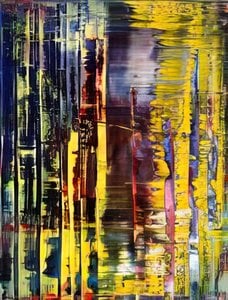
The Genesis of Ambiguity: Basel 2 by Gerhard Richter
Gerhard Richter's "Basel 2," a work often considered a cornerstone of his mature style, isn’t merely a painting; it’s an invitation to contemplate the very nature of perception and representation. Created in 1987, during a period when Richter was increasingly exploring abstraction while retaining echoes of photographic realism, this piece embodies a profound shift within his oeuvre – a deliberate embrace of uncertainty and a rejection of definitive meaning. The canvas presents a landscape of muted grays, predominantly horizontal streaks and amorphous shapes that seem to dissolve into one another, creating an atmosphere thick with suggestion rather than explicit narrative. It’s a visual poem, less about depicting a specific scene and more about evoking a feeling – a sense of quiet contemplation, perhaps even melancholy.
Richter's technique is central to the work’s impact. He employed a method he termed “allag,” utilizing squeegees to apply paint in multiple layers, often overlapping them extensively. This process deliberately obscures sharp edges and introduces a textural richness that defies simple categorization. The blurring isn’t accidental; it’s a conscious decision to move away from the illusion of depth and surface detail, instead focusing on the interplay of light, shadow, and color within the layered application itself. The result is an image that feels both solid and ephemeral, grounded in materiality yet simultaneously dissolving into abstraction.
A Dialogue with Richter’s Predecessors: The Influence of Gerhard Richter
To fully appreciate "Basel 2," it's crucial to understand the context within which Richter was working. His style owes a significant debt to earlier artists, particularly German Expressionists like Franz Marc and Wassily Kandinsky, who similarly explored the expressive potential of color and form. However, Richter’s approach differs in its systematic deconstruction of representation. He builds upon the foundations laid by these pioneers while simultaneously pushing beyond them, creating a distinctly modern aesthetic. The influence of Gerhard Richter is evident in his work, particularly his use of blurred images and layered techniques.
Furthermore, Richter's exploration of photography – he spent years meticulously photographing photographs and then painting them – profoundly shaped his artistic practice. "Basel 2" can be seen as a distillation of this process, retaining the inherent ambiguity of photographic reproduction while simultaneously transforming it into something entirely new. The work’s ghostly quality, its sense of being both present and absent, reflects Richter's ongoing interrogation of the relationship between reality and representation.
Decoding the Layers: Composition, Color, and Technique
The composition of "Basel 2" is deceptively simple yet remarkably complex. The dominant horizontal lines create a sense of rhythm and movement, guiding the viewer’s eye across the canvas. These lines aren't uniformly applied; they vary in thickness and opacity, contributing to the overall textural richness. The grayscale palette – ranging from pale grays to deep blacks – reinforces the work’s atmosphere of quiet contemplation and understated emotion. There is a subtle shift in tone that adds depth and dimension, preventing the image from feeling flat or monotonous.
Richter's technique is particularly noteworthy. The application of paint with the squeegee results in a distinctive painterly texture – a surface that is both smooth and subtly uneven. This textural quality is crucial to the work’s impact, adding another layer of complexity to its visual language. It’s important to note that Richter often worked on multiple layers, building up the image gradually over time, allowing each layer to partially obscure the one beneath it. This layering process contributes significantly to the sense of depth and ambiguity inherent in "Basel 2."
Beyond Representation: The Emotional Resonance of Basel 2
Ultimately, “Basel 2” is not about depicting a specific scene or object; it’s about evoking an emotional response. The blurred forms suggest landscapes, urban scenes, or perhaps even abstract memories – but these associations are deliberately ambiguous, inviting the viewer to project their own experiences and interpretations onto the canvas. The painting's quiet intensity speaks to a deeper sense of introspection, prompting viewers to contemplate the nature of reality, perception, and the limitations of representation.
As a reproduction, "Basel 2" captures much of the original’s atmospheric quality. The subtle variations in tone and texture are faithfully reproduced, allowing viewers to experience the painting's emotional resonance even when viewed from afar. It remains a powerful testament to Richter’s artistic vision – a work that continues to challenge and intrigue audiences decades after its creation.



 미리보기
미리보기
 손으로 그린 그림 구매
 공유하기
공유하기 공유하기
공유하기
 상세 정보
상세 정보

 다운로드
다운로드
 유사 작품
유사 작품 X-레이
X-레이 슬라이드 쇼

 더 보기
더 보기






































 유리 옵션은 110cm 미만 크기에서만 선택 가능합니다.