オンラインプレビューをはるかに凌ぐ、高解像度で鮮明なデジタル画像をご購入いただけます。
各ファイルは、社内の専門家が高度なツールと熟練した手作業によるレタッチを用いて、細心の注意を払って準備されています。すべての画像において、卓越した鮮明度、正確な色彩再現性、そして繊細なディテールを保証いたします。
最終ファイルは、プロフェッショナルな編集・印刷環境ですぐにご利用いただけるよう最適化された状態で、72時間以内にメールにてお届けいたします。これは、一流のデザインスタジオ、出版社、ギャラリーから信頼されているものと同等の品質です。
WahooArt.com を選ぶことは、単に画像を手に入れることではありません。それは、プロの手によって精密に仕上げられ、満足保証が付いた高品質なデジタルアートワークを受け取ることを意味します。ご注文いただいた際に自動的に付随する内容は、以下の通りです:

ご注文から72時間以内に、高解像度のデジタル画像ファイルがメールでお手元に届きます。すぐにそのままご利用いただけます。

お客様の作品は、高度なAIツールと専門家による手作業の編集を組み合わせてプロフェッショナルに最適化されており、細部のディテール、鮮明さ、そして正確な色再現性を最大限に引き出しています。

ファイルを誤って削除したり、紛失してしまったりしましたか?ご安心ください。いつでも無料で再送いたします。

関税や手数料、配送料を気にすることなく、お気に入りのアートワークをすぐにお楽しみいただけます。デジタルダウンロードは常に免税です。

プロ仕様のツールとカラーマネジメント技術を用いることで、デジタル画像が元の色を最大限に忠実に再現することを保証いたします。

ご購入いただいたデジタル画像にご満足いただけない場合は、100日以内であれば、修正または100%の返金(理由を問う必要はありません)をさせていただきます。

ご満足いただけない場合は、デジタルファイルを受け取ってから100日以内であれば、理由を問わず全額返金いたします。

3枚購入で10%OFF - 5枚購入で15%OFF - 10枚以上購入で20%OFF。クリエイティブなプロジェクト、ギャラリー、エージェンシーに最適です。
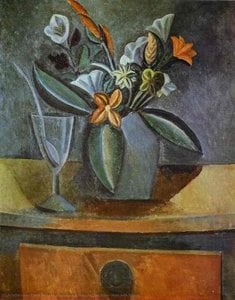
Pablo Picasso's “Flowers on a Table 1,” painted in 1907, isn’t merely a depiction of a vase and its contents; it’s a pivotal moment in the development of Cubism – a radical departure from traditional representation that would forever alter the course of art history. This particular iteration, often considered one of Picasso's earliest explorations of the style alongside “Still Life with Fruit,” offers a fascinating glimpse into his nascent ideas about form and space. The painting’s yellowish tint, hinting at age and perhaps even a faded memory, immediately establishes an atmosphere of quiet contemplation, inviting us to step closer and decipher the fragmented reality presented before us.
The scene is deceptively simple: a metal vase, holding a collection of everyday objects – scissors, a knife, spoons, a bowl, a cup, and a bottle – arranged on a table. However, Picasso doesn’t offer a unified, cohesive view. Instead, he dismantles the forms, breaking them down into geometric shapes and presenting multiple perspectives simultaneously. The vase itself isn't rendered as a single, solid volume; it appears to be constructed from overlapping planes of color and line, suggesting its inherent instability and challenging our perception of depth. This deliberate fracturing is characteristic of Cubism’s core principle – to represent objects not as they appear to the eye in a single moment, but as they are perceived by the mind, assembled from various viewpoints.
“Flowers on a Table 1” stands as a crucial stepping stone toward what would become known as Analytical Cubism. Following his encounter with Paul Cézanne’s work – particularly the artist's emphasis on geometric forms and multiple viewpoints – Picasso began to experiment with breaking down objects into their constituent parts, analyzing them from different angles before reassembling them in an abstract composition. This process is evident here; each element—the vase, the utensils—is dissected and presented as a collection of interlocking planes, creating a sense of dynamism and spatial ambiguity. The lack of traditional shading or modeling further emphasizes this fragmented approach, forcing the viewer to actively engage with the artwork and reconstruct its form in their own mind.
Interestingly, Picasso’s exploration of still life coincided with a period of personal upheaval. His sister Conchita's death profoundly affected him, and themes of loss and mortality subtly permeate his work during this time. While not overtly melancholic, the painting carries an undercurrent of fragility and impermanence—a reflection perhaps of the transient nature of beauty and the inevitability of decay. The muted color palette contributes to this mood, creating a sense of quiet introspection.
Despite its abstract qualities, “Flowers on a Table 1” is deeply rooted in the everyday. The objects depicted – a vase, scissors, knives, spoons—are familiar and commonplace, yet Picasso elevates them to an artistic level through his innovative approach. These tools of domesticity become symbols of human activity, hinting at the rituals and routines of daily life. The arrangement itself can be interpreted as a meditation on order versus chaos, suggesting a delicate balance between functionality and abstraction. The inclusion of the chair in the background subtly anchors the scene within a recognizable space, providing a point of reference for the viewer’s interpretation.
“Flowers on a Table 1” is more than just a still life; it’s a manifesto. It represents a radical shift in artistic thinking, paving the way for future generations of artists to explore abstraction and challenge traditional notions of representation. Picasso’s pioneering work laid the foundation for Synthetic Cubism, where he began incorporating collage elements into his paintings, further blurring the boundaries between art and reality. Today, reproductions of this seminal piece continue to captivate viewers with its innovative composition, evocative atmosphere, and profound exploration of form and perception. WahooArt offers meticulously crafted hand-painted reproductions that faithfully capture the essence of this groundbreaking artwork, allowing you to experience Picasso’s revolutionary vision firsthand.


1881 - 1973 , スペイン


 プレビュー
プレビュー
 プリントを購入
 シェアする
シェアする シェアする
シェアする
 詳細を見る
詳細を見る

 ダウンロード
 似ている作品
 X線調査
X線調査 スライドショー
 詳細を見る
詳細を見る