x































作品のオリジナル比率に合わせた、当店の規定サイズからお選びください。

特定のフレームやスペースに合わせて、ご希望のサイズをご入力いただけます。選択されたサイズが元の画像の比率と異なる場合、アートワークをトリミングするか、手描きで要素を追加して絵画を拡張いたします。デジタルモックアップ を制作し、制作開始前にご確認(承認)をいただきます。
画面上のプレビューは、実際のトリミングや拡張を正確に反映しているものではありません。最終的な構図は、モックアップによってのみ正確にご確認いただけます。
カスタムサイズもご利用いただけますが、元の比率を維持するためには、あらかじめ用意されたリストからサイズを選択することをお勧めいたします。

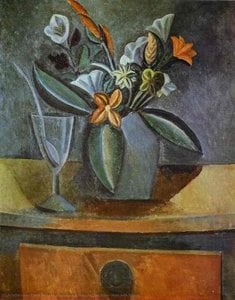
Flowers on a table 1
複製画のサイズ
Pablo Picasso's “Flowers on a Table 1,” painted in 1907, isn’t merely a depiction of a vase and its contents; it’s a pivotal moment in the development of Cubism – a radical departure from traditional representation that would forever alter the course of art history. This particular iteration, often considered one of Picasso's earliest explorations of the style alongside “Still Life with Fruit,” offers a fascinating glimpse into his nascent ideas about form and space. The painting’s yellowish tint, hinting at age and perhaps even a faded memory, immediately establishes an atmosphere of quiet contemplation, inviting us to step closer and decipher the fragmented reality presented before us.
The scene is deceptively simple: a metal vase, holding a collection of everyday objects – scissors, a knife, spoons, a bowl, a cup, and a bottle – arranged on a table. However, Picasso doesn’t offer a unified, cohesive view. Instead, he dismantles the forms, breaking them down into geometric shapes and presenting multiple perspectives simultaneously. The vase itself isn't rendered as a single, solid volume; it appears to be constructed from overlapping planes of color and line, suggesting its inherent instability and challenging our perception of depth. This deliberate fracturing is characteristic of Cubism’s core principle – to represent objects not as they appear to the eye in a single moment, but as they are perceived by the mind, assembled from various viewpoints.
“Flowers on a Table 1” stands as a crucial stepping stone toward what would become known as Analytical Cubism. Following his encounter with Paul Cézanne’s work – particularly the artist's emphasis on geometric forms and multiple viewpoints – Picasso began to experiment with breaking down objects into their constituent parts, analyzing them from different angles before reassembling them in an abstract composition. This process is evident here; each element—the vase, the utensils—is dissected and presented as a collection of interlocking planes, creating a sense of dynamism and spatial ambiguity. The lack of traditional shading or modeling further emphasizes this fragmented approach, forcing the viewer to actively engage with the artwork and reconstruct its form in their own mind.
Interestingly, Picasso’s exploration of still life coincided with a period of personal upheaval. His sister Conchita's death profoundly affected him, and themes of loss and mortality subtly permeate his work during this time. While not overtly melancholic, the painting carries an undercurrent of fragility and impermanence—a reflection perhaps of the transient nature of beauty and the inevitability of decay. The muted color palette contributes to this mood, creating a sense of quiet introspection.
Despite its abstract qualities, “Flowers on a Table 1” is deeply rooted in the everyday. The objects depicted – a vase, scissors, knives, spoons—are familiar and commonplace, yet Picasso elevates them to an artistic level through his innovative approach. These tools of domesticity become symbols of human activity, hinting at the rituals and routines of daily life. The arrangement itself can be interpreted as a meditation on order versus chaos, suggesting a delicate balance between functionality and abstraction. The inclusion of the chair in the background subtly anchors the scene within a recognizable space, providing a point of reference for the viewer’s interpretation.
“Flowers on a Table 1” is more than just a still life; it’s a manifesto. It represents a radical shift in artistic thinking, paving the way for future generations of artists to explore abstraction and challenge traditional notions of representation. Picasso’s pioneering work laid the foundation for Synthetic Cubism, where he began incorporating collage elements into his paintings, further blurring the boundaries between art and reality. Today, reproductions of this seminal piece continue to captivate viewers with its innovative composition, evocative atmosphere, and profound exploration of form and perception. WahooArt offers meticulously crafted hand-painted reproductions that faithfully capture the essence of this groundbreaking artwork, allowing you to experience Picasso’s revolutionary vision firsthand.


1881 - 1973 , スペイン

Explore the profound evolution of Cubism through an expert analysis of Pablo Picasso's revolutionary works. From Analytical to Synthetic Cubism, discover the techniques that redefined modern art and learn how to curate these iconic masterpieces for your private collection.


最新の美術ニュース、限定オファー、そしてインテリアのアイデアをいち早くお届けします。
お客様のプロジェクトについてお聞かせください。当社の美術専門家が、お客様に合わせた3つのパーソナライズされた芸術提案をご提供いたします。
あなたにぴったりの3作品を無料で厳選いたします


 プレビュー
プレビュー
 プリントを購入
 シェアする
シェアする シェアする
シェアする
 詳細を見る
詳細を見る

 ダウンロード
 似ている作品
 X線調査
X線調査 スライドショー
 詳細を見る
詳細を見る









 ガラスオプションは、110cm未満のサイズでのみご利用いただけます。