


このページに掲載されている作品は著作権法によって保護されており、当社の許可なく同一の複製物を制作または販売することは法律で禁じられています。この保護は、以下のような国際条約に基づき執行されます。 ベルヌ条約 および、以下の条項に定められたものを含む各国の法律により、 米国著作権法 第17編。
この手法は、著作権で保護された作品の複製や複写を伴わないため、著作権法に完全に準拠しています。これは単なる模倣ではなく、創造的な再解釈です。元の作品からインスピレーションを受けつつも、それとは異なる、全く新しい絵画を生み出すものです。
スピーディーな制作と多彩な仕上げオプションが魅力の、ミュージアムクオリティなジークレー・キャンバスプリント。 ( 手描き複製画を注文する デジタル画像販売へ切り替え)





























作品のオリジナル比率に合わせた、当店の規定サイズからお選びください。

額縁や壁のスペースに合わせて、ご希望の幅と高さを入力してください。プリントはカットすることは可能ですが、元の画像より大きくすることはできないため、異なる比率のサイズを選択された場合は、画像の一部が欠けることになります。印刷を開始する前に、内容を確認していただくためのデジタルモックアップをお送りいたします。このページに表示されている画像は、実際のカット後の状態を示すものではありません。実際の仕上がりはモックアップにてご確認ください。
Alms
複製画サイズ一覧
To stand before Alms by Montien Boonma is to enter a space suspended between the tangible and the ephemeral. This painting transcends a mere depiction of objects; it offers a meditation on absence, suggestion, and the enduring spirit embedded within everyday ritual. The composition, dominated by a substantial table surface upon which an array of cups rests, immediately draws the eye into a study of geometry and quiet accumulation. It is a scene steeped in the profound tradition of Buddhist mendicancy, yet rendered through a lens so modern that it feels both deeply rooted in history and startlingly contemporary.
Boonma’s mastery here lies not just in his ability to render form—the varying sizes and graceful curves of the cups are executed with meticulous care, suggesting a high degree of technical proficiency—but in what he chooses to omit. The description notes that instead of directly painting hands holding the bowls, Boonma suggests their existence by leaving marks upon the clay itself. This is the core genius of the piece: transforming the visible act into an invisible residue. It forces the viewer’s mind to complete the circuit, to participate in the narrative. Furthermore, the structural tension, hinted at by the delicate moulding supporting solid volumes, speaks to a sophisticated understanding of balance, making the entire arrangement feel poised on the edge of gravity.
The theme of religious mendicancy anchors the work in the cultural heartland of Thailand. The cups are not simply vessels; they are conduits for devotion, symbols of giving, receiving, and the cyclical nature of sustenance. By elevating this ordinary motif—the collection of alms bowls—into such a refined and modern visual language, Boonma invites us to reconsider what holds spiritual weight in our own lives. It prompts an inquiry into the invisible things: the unseen acts of generosity, the quiet moments of contemplation that define a life lived with intention.
For the collector or designer seeking art that speaks volumes without shouting, Alms offers unparalleled depth. Its sophisticated palette and intricate arrangement allow it to anchor a room with intellectual gravity. It functions beautifully in spaces that appreciate both cultural reverence and minimalist modernism. The painting doesn't demand attention; rather, it earns it through its quiet complexity. Owning this piece is acquiring not just a beautiful object for the wall, but a thoughtful conversation starter—a visual prompt to pause, observe, and contemplate the beauty found in suggestion.
Montien Boonma作「Alms」の主色(メインカラー)はEspresso (#39201e)です。
Montien Boonma作「Alms」は福岡アジア美術館, 福岡, 日本に展示されています。なお、美術館の掲載情報は複製画ではなく、原画に関するものです。
原画Montien Boonma作「Alms」のサイズは300 x 66 cmです。

To encounter the work of Montien Boonma is to step into a space where the boundaries between the physical world and the spiritual realm begin to dissolve. Born in Bangkok, Thailand, Boonma emerged as one of the most gifted contemporary sculptors working in Southeast Asia, a pioneer who bridged the gap between local traditions and international conceptual frameworks. His practice was never merely about the creation of objects; rather, it was an invitation to meditation, a way to navigate the profound tensions of a rapidly modernizing Thai society. Through his mastery of both high-tech media and ephemeral, organic materials, he crafted an aesthetic language that spoke of the transient nature of existence.
Boonma’s artistic journey was shaped by a rigorous academic foundation, having earned a Master of Fine Arts from Silpakorn University in Bangkok before furthering his studies in France at the École Nationale Supérieure des Beaux-Arts, Paris, and the Université de Paris VIII. This dual exposure to Thai cultural roots and European intellectualism allowed him to develop a unique sculptural voice. He was deeply influenced by the arte povera movement and the works of sculptors such as Tony Cragg and Bill Woodrow, yet his work remained anchored in the spiritual heartland of Thailand. His sculptures often functioned as sensory experiences, utilizing scent, sound, and sight to draw the viewer into a state of contemplation.
The essence of Boonma’s practice lay in his ability to transform everyday materials into conduits for devotion. A devout Buddhist, he utilized familiar religious symbols—the bowl, the bell, and the lotus—to ground his work within a specific ritualistic system. However, he avoided mere nostalgia, instead using these icons to address contemporary anxieties regarding environmental pollution, urban expansion, and the shifting landscape of spiritual life. His installations were often immersive, employing aromatic herbs, medicinal pigments, and earthy elements like rice flour, terracotta, wood, ash, and soil to create a palpable atmosphere of sanctity.
In his most celebrated works, such as House of Hope, Boonma transformed gallery spaces into temple-like environments. He might paint walls with herbal pigments that released subtle fragrances, or suspend thousands of beads to mimic the sensation of "black rain" bringing hope. These pieces were not just visual displays but psychological landscapes designed to focus the spiritual body through physical sensation. His use of materials was intentionally elemental and often perishable, reflecting his view of life as a perpetual cycle of change and movement—a concept he frequently illustrated through the use of spiral shapes and question marks, symbolizing the journey from the exterior self to the inner being.
The trajectory of Boonma’s career was marked by both immense international recognition and profound personal tragedy. He was a rising star on the global biennial circuit, participating in prestigious exhibitions such as the 8th Biennale of Sydney, the Liverpool Biennale, and the Asia-Pacific Triennial of Contemporary Art in Brisbane. Despite his growing fame, his later years were shadowed by illness; diagnosed with cancer in mid-1999, he continued to create vital works until his death. This period of personal struggle added a layer of poignant depth to his explorations of mortality and the ephemeral.
Today, Montien Boonma is remembered as a pathfinder who provided an alternative conceptual framework for contemporary sculpture in Asia. His ability to synthesize the primitive with the modern, and the rural with the urban, ensures that his work remains strikingly relevant. His legacy is preserved in prestigious institutions worldwide, including:

1953 - 2003 , Thailand
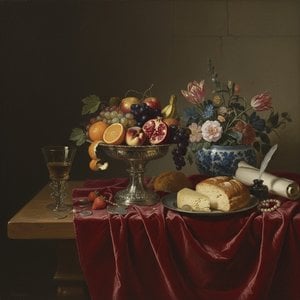
Embark on a sophisticated journey through the history of still life art. From Dutch Golden Age masterpieces to Baroque opulence, explore the profound symbolism and timeless beauty of the world's most exquisite table compositions.

Explore the profound beauty of fruit arrangement masterpieces. From Dutch Golden Age opulence to Baroque chiaroscuro, discover the art history, symbolism, and timeless elegance of classical still life paintings for the discerning collector.
 設置イメージを表示
 シェアする
シェアする シェアする
シェアする
 詳細を見る
詳細を見る ガイドを表示

 ダウンロード
 似ている作品
 X線調査
X線調査 スライドショーを表示
 Q&A
Q&A
 統計情報
統計情報

 詳細を表示
詳細を表示









 ガラスオプションは、110cm未満のサイズでのみご利用いただけます。


