

スピーディーな制作と多彩な仕上げオプションが魅力の、ミュージアムクオリティなジークレー・キャンバスプリント。 ( 手描きの複製画を注文する デジタル画像販売へ切り替え)





























作品のオリジナル比率に合わせた、当店の規定サイズからお選びください。

額縁や壁のスペースに合わせて、ご希望の幅と高さを入力してください。プリントはカットすることは可能ですが、元の画像より大きくすることはできないため、異なる比率のサイズを選択された場合は、画像の一部が欠けることになります。印刷を開始する前に、内容を確認していただくためのデジタルモックアップをお送りいたします。このページに表示されている画像は、実際のカット後の状態を示すものではありません。実際の仕上がりはモックアップにてご確認ください。
Barbier
複製画サイズ一覧

Abraham Bosse stands as a pivotal figure in French Baroque art, celebrated primarily for his groundbreaking etchings that captured the vibrant tapestry of seventeenth-century Paris and its aristocratic circles. Born to Huguenot parents in Tours, France—a city scarred by religious conflict—Bosse’s formative years instilled within him a profound appreciation for detail and observation, qualities that would define his artistic vision throughout his prolific career. His father was a tailor, providing Bosse with an early understanding of craftsmanship and meticulous rendering, skills he would later translate into the exacting precision of his prints.
The trajectory of his life took a decisive turn when he moved toward greater horizons, embarking on a formal apprenticeship with Melchior Tavernier, an Antwerp-born engraver and publisher, around 1620. This partnership proved instrumental in establishing his reputation as one of the era's foremost printmakers. Tavernier’s influence extended beyond mere technical guidance; he fostered Bosse’s burgeoning fascination with artistic innovation and encouraged him to explore diverse subjects. Early etchings, notably those produced under Tavernier’s patronage, demonstrated a nascent stylistic sensibility rooted in Dutch and Flemish art traditions—a deliberate choice that simultaneously honored established precedents while subtly injecting them with distinctly French nuances.
A pivotal encounter with Jacques Callot in Paris around 1630 irrevocably altered Bosse's artistic trajectory. Callot’s revolutionary etching techniques—characterized by a remarkable level of textural detail and a masterful manipulation of tonal gradation—became an immediate inspiration for Bosse, who enthusiastically adopted these innovations. This embrace of Callot’s approach resulted in prints that possessed an unparalleled realism, allowing Bosse to render the delicate textures of lace, the sheen of silk, and the complex architectural perspectives of Parisian interiors with breathtaking clarity.
Bosse's work often transcended simple documentation, moving into the realm of social commentary and allegorical depth. His ability to weave together the mundane and the magnificent is evident in several key themes of his oeuvre:
Beyond the copperplate, Bosse’s impact on the art world was institutional and enduring. As a founding member of the Académie Royale, he helped shape the formal standards of French art, ensuring that the precision and observational rigor he championed would become hallmarks of the national style. His meticulous attention to fashion and interior design has made his work an invaluable primary source for historians seeking to understand the material culture of the 17th century.
The influence of Bosse’s unique blend of realism and technical innovation extended far beyond the borders of France, reaching later masters such as William Hogarth. By bridging the gap between the meticulous traditions of Northern Europe and the burgeoning grandeur of the French Baroque, Abraham Bosse created a visual language that remains as captivating today as it was during the reign of Louis XIV. His legacy lives on in every fine line of his etchings, which continue to breathe life into the vanished world of old Paris.

1604 - 1676 , France

Explore the profound mastery of engraving and intaglio printmaking. Delve into the rich history, technical precision of the burin, and the enduring legacy of fine art techniques that shaped the world's most iconic masterpieces.
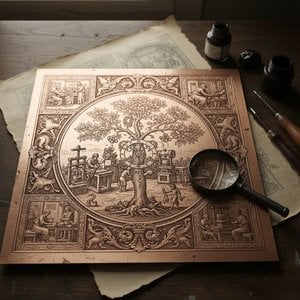
Explore the intricate world of etching and intaglio printmaking. Discover how masters use acid and metal to create profound textures and lines, from Romanticism to modern era, through an expert lens of art history and technical mastery.

 設置イメージを確認
 送る
送る シェア
シェア
 詳細情報
詳細情報 ガイドを表示

 画像をダウンロード
 似ている作品
 X線調査
X線調査 スライドショー
 統計情報
統計情報
 続きを読む
続きを読む









 ガラスオプションは、110cm未満のサイズでのみご利用いただけます。


