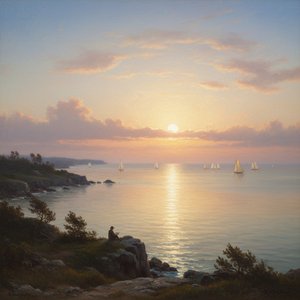
The Quiet Contemplation of Xiao Xun
Xiao Xun emerges as a compelling voice in contemporary Chinese painting, though his work is deeply rooted in the traditions of millennia past. Born into an era of rapid change, he has chosen to embrace and refine the aesthetics of classical landscape and calligraphy, offering viewers a sanctuary of serenity amidst the modern world’s clamor. While biographical details remain intentionally sparse – Xiao Xun prefers that his art speak for itself – it is understood he began rigorous training in traditional techniques at a young age, dedicating himself to mastering the brushstrokes and ink washes that define the genre. His connection to WahooArt represents not merely a commercial partnership but a deliberate platform for sharing this refined vision with a wider audience. He operates from Suihan Studio Art, a space dedicated to preserving and promoting authentic Chinese artistic practices.
A Legacy of Ink: Influences and Early Development
The lineage of Xiao Xun’s art is readily apparent in the works of the Song Dynasty masters – artists like Fan Kuan and Guo Xi whose monumental landscapes evoked both awe-inspiring grandeur and profound philosophical contemplation. He draws heavily from these precedents, but does not simply replicate them. Instead, he internalizes their principles—the use of layered washes to create depth, the strategic placement of trees and mountains to guide the viewer’s eye, the subtle interplay of emptiness and form—and reinterprets them through a distinctly contemporary sensibility. Shanshui (mountain-water) painting is central to his practice; it's not merely representation but an attempt to capture the essence of nature, its rhythms and energies. Early works demonstrate a meticulous attention to detail, a striving for technical perfection that laid the foundation for his later explorations of more expressive styles. He also studied calligraphy extensively, recognizing its integral role in Chinese painting – often incorporating poems or inscriptions into his landscapes, adding layers of meaning and context.
The Art of Restraint: Technique and Symbolism
Xiao Xun’s paintings are characterized by a remarkable sense of restraint. He employs a limited palette, primarily relying on shades of black ink, with occasional touches of subtle color. This deliberate simplicity is not an absence of skill but rather a testament to his mastery of the medium. Each brushstroke is carefully considered, imbued with intention and nuance. The texture of the paper itself becomes an integral part of the composition, adding depth and visual interest. Beyond technical prowess, Xiao Xun’s work is rich in symbolism. Mountains represent stability and permanence, water embodies fluidity and change, trees signify growth and resilience. The empty spaces within his compositions are just as important as the forms themselves, representing the void from which all things arise – a core concept in Taoist philosophy. His landscapes aren’t depictions of specific places but rather evocations of inner states, invitations to quiet contemplation.
Contemporary Resonance: Achievements and Historical Significance
In an art world often dominated by novelty and experimentation, Xiao Xun's commitment to tradition is a bold statement. He has achieved significant recognition for his ability to breathe new life into classical forms, appealing to both seasoned collectors and those newly discovering the beauty of Chinese painting. His work transcends cultural boundaries, resonating with viewers who appreciate its inherent tranquility and spiritual depth. While it’s premature to definitively assess his long-term historical significance, Xiao Xun is undoubtedly playing a crucial role in preserving and promoting an invaluable artistic heritage. He demonstrates that tradition isn't static but rather a living force capable of evolving and adapting to contemporary sensibilities. His paintings serve as a powerful reminder of the enduring power of nature and the importance of finding moments of peace in a chaotic world, solidifying his position as a vital artist within the Chinese art landscape and beyond.