William Philip Barns Freeman: A Norfolk Visionary
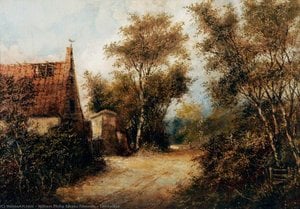
William Philip Barns Freeman (born circa 1860, died 1937) stands as a singular figure in British landscape art of the late Victorian and Edwardian eras. Primarily celebrated for his meticulous depictions of Norfolk’s coastline and rural interiors—particularly Costessey Weir and Cromer—Freeman achieved renown not merely for capturing picturesque vistas but for imbuing them with profound psychological depth and an unwavering commitment to artistic realism. His canvases are imbued with a palpable sense of atmosphere, reflecting the subtle interplay of light and shadow that defines Norfolk’s landscapes and conveying a harmonious balance between architectural grandeur and natural serenity.
Early Life & Education
Freeman's formative years were spent in Norwich, where he received a robust classical education at Norwich Cathedral School. This grounding in humanist scholarship instilled within him a lifelong fascination with mythology and literature—influences that would profoundly shape his artistic sensibilities. Recognizing his aptitude for sculpture, Freeman pursued formal training at the Royal Academy Schools in London, mastering techniques honed by masters like Auguste Rodin. His sculptural output during this period showcased an impressive command of form and anatomy, mirroring the stylistic trends prevalent at the time. Notable sculptures include “The Shepherdess,” a poignant depiction of rural life rendered with delicate precision, and “Saint George and the Dragon,” embodying Rodin’s commitment to conveying psychological complexity through anatomical realism—a testament to Freeman's artistic erudition.
Sculpture Training & Initial Works
Freeman’s sculptural endeavors solidified his reputation as a skilled craftsman and demonstrated his mastery of bronze casting—a technique he honed with unwavering dedication. His early sculptures, such as “The Shepherdess,” exemplify the humanist ideals championed by Rodin, reflecting Freeman's profound appreciation for classical art and philosophy. Furthermore, his meticulous attention to detail—evident in every curve and contour—underscored his commitment to artistic accuracy and expressive dynamism.
Transition to Landscape Painting
Despite his sculptural accomplishments, Freeman’s artistic passion ultimately gravitated toward landscape painting—a decision driven by an ambition to translate the emotional resonance of Norfolk's landscapes onto canvas with unparalleled precision. Around 1890, he embarked on a deliberate exploration of Norfolk’s vistas, fueled by a desire to capture not merely visual appearances but also the intangible qualities that define their character. This transformative journey culminated in his groundbreaking depictions of Costessey Weir and Cromer—works that cemented Freeman's place as a pioneer of psychological landscape painting.
Norfolk Landscapes: A Synthesis of Observation & Emotion
Freeman’s approach to landscape painting distinguished itself from its contemporaries by prioritizing atmospheric representation over mere visual replication. He meticulously studied the effects of light on landscape surfaces—employing a palette knife to build up textured layers that captured the nuances of atmospheric conditions—a technique he adopted directly from Impressionist masters like Claude Lorrain. His canvases are characterized by luminous color palettes—often dominated by hues of amber and rose—mirroring the ethereal glow of twilight over Cromer Pier, creating an immersive experience for the viewer. Moreover, Freeman’s compositions—characterized by masterful use of perspective—effectively convey the drama and beauty of Norfolk's iconic coastal scenes.
Freeman’s enduring legacy rests upon his unwavering dedication to artistic realism—coupled with his ability to evoke profound emotions—establishing him as a cornerstone of British landscape art. His canvases continue to captivate audiences worldwide, serving as emblems of Norfolk’s pastoral charm and the transformative power of artistic vision—a testament to William Philip Barns Freeman's singular contribution to the artistic canon.