Early Life and Training
Wilhelm Marstrand, born December 24, 1810, in Copenhagen, Denmark, was nurtured by a father who championed artistic pursuits—Nicolai Jacob Marstrand, an instrument maker and inventor—a formative influence that shaped his lifelong passion for art. At the tender age of sixteen, he enrolled at the Academy under the watchful eye of Christian Waagepetersen, a wine merchant to the Danish court and fervent supporter of artistic endeavors. This initial mentorship proved pivotal in establishing Marstrand’s foundational understanding of artistic principles.Artistic Career
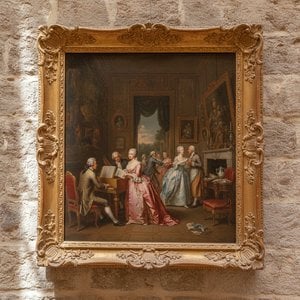
Marstrand's artistic journey commenced with an unwavering fascination for genre painting, capturing the vibrant tapestry of daily life within Copenhagen’s bustling streets. His seminal work, “A Musical Evening Party” (et musikalsk aftenselskab) (1834), presented at the National Gallery of Denmark (Copenhagen, Denmark), exemplifies his masterful ability to distill the spirit of middle-class society onto canvas—a testament to his observational skill and artistic sensitivity. Despite not securing the academy’s prestigious gold medal, Marstrand received a generous travel stipend, propelling him on an unforgettable four-year expedition to Italy (1836-1840). This transformative period profoundly impacted his oeuvre, as evidenced by “Italian Festival” (1842), showcased at WahooArt.com—a bold declaration of his admiration for Italian culture and artistic traditions.Notable Works
Marstrand’s artistic output encompassed a diverse range of subjects, reflecting his intellectual curiosity and artistic versatility. Among his most celebrated creations are: * Erasmus Montanus (1843): This monumental painting served as Marstrand's admissions piece to the Academy, cementing his position as a respected instructor and furthering his commitment to artistic education. * Italian Festival (1842): A radiant depiction of Italian life—a vibrant celebration of color, movement, and human interaction—demonstrates Marstrand’s unwavering fascination with the Italian landscape and its people.Influences and Legacy
Marstrand's artistic vision was shaped by several key figures: Christian Waagepetersen, whose guidance instilled in him a deep appreciation for classical aesthetics; Ludvig Holberg, whose literary works fostered an understanding of human psychology and storytelling; and crucially, the immersive experience of Italian culture itself. He nurtured the talents of numerous aspiring artists—Peder Severin Krøyer, Michael Ancher, Carl Bloch, and Kristian Zahrtmann—leaving behind a legacy as a teacher who championed realism and artistic innovation. His enduring contribution to Danish art continues to inspire admiration and scholarly study.Travel
Marstrand’s extensive travels – encompassing Italy, London, Vienna, and Belgium – broadened his artistic horizons and exposed him to diverse cultural influences, enriching his creative perspective and informing the stylistic nuances of his paintings.Domande e risposte
Come si è evoluta l'arte di Wilhelm Marstrand nel tempo?
La Cronologia di Wilhelm Marstrand è una linea temporale a scorrimento che presenta le opere dell'artista in ordine cronologico, suddivise in capitoli relativi ai diversi periodi della sua carriera.
Dove si trovano le opere di Wilhelm Marstrand raggruppate per movimento artistico?
La pagina Tutti i movimenti raggruppa le opere di Wilhelm Marstrand per movimento artistico.
È disponibile un tour virtuale 3D delle opere di Wilhelm Marstrand?
Le opere di Wilhelm Marstrand sono visibili in una galleria 3D nella pagina Museo 3D dell'artista.