Walter Spies: A Pioneer of Balinese Art and Modern Indonesian Expression
Walter Spies (1895-1942) stands as a singular figure in the annals of modern Indonesian art, credited with initiating a crucial dialogue between European artistic sensibilities and the vibrant traditions of Bali. Born in Russia to German diplomat parents, his formative years instilled within him an appreciation for both Western scholarship and Eastern mysticism – influences that would profoundly shape his artistic vision and lifelong dedication.
His early career saw Spies honing his skills as a composer and musicologist, demonstrating a multifaceted intellectual curiosity beyond the realm of painting. However, it was his relocation to Java in 1923, spurred by an irresistible fascination with Balinese culture, that cemented his legacy. Immediately captivated by the island’s rituals, dances, and artistic heritage, Spies embarked on a transformative journey – one that would not only enrich his own creative output but also propel Bali onto the international stage as a beacon of primitivism and authentic cultural experience.
Spies quickly established himself in Yogyakarta and later Ubud, becoming instrumental in fostering collaborations between Balinese artists and Western intellectuals. Notably, he befriended Miguel Covarrubias, an anthropologist who documented Spies’s immersive explorations of Balinese life, capturing the essence of their shared fascination with the island's traditions. Covarrubias eloquently described Spies as “the son of a German diplomat in Moskow at the outbreak of the world war,” highlighting his privileged upbringing and early exposure to intellectual pursuits. He was recognized as "a fine musician as he was a painter," demonstrating an exceptional talent across multiple disciplines.
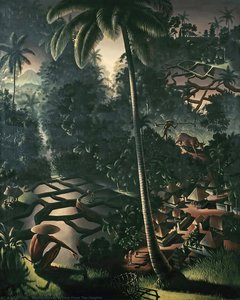
Spies’s artistic style is characterized by a distinctive primitivist aesthetic – a deliberate rejection of academic conventions in favor of raw emotion, bold color palettes, and simplified forms reminiscent of early European Expressionism and Cézanne's landscapes. He meticulously documented Balinese ceremonies and rituals through evocative paintings like “Sekaten 1926” and “A View From The Heights,” capturing the dynamism and spiritual depth of Balinese culture with unparalleled accuracy. His approach mirrored that of masters such as Matisse, Breughel, and Rousseau—artists who prioritized emotional resonance over technical precision. He sought to convey a sense of immediacy and spontaneity, mirroring the rhythms of daily life in Bali.
Furthermore, Spies’s meticulous observation extended beyond visual art; he painstakingly drew insects, spiders, and sea slugs, documenting their beauty in detail with a dedication akin to a naturalist's pursuit. This passion for capturing the natural world translated into his paintings, where every branch and leaf is rendered with loving care—a testament to his artistic philosophy. Spies’s influence resonated far beyond Bali itself, attracting prominent figures from across Europe who sought to understand and appreciate Balinese culture firsthand. He remains a pivotal figure in establishing Bali as an internationally recognized center for artistic innovation and cultural exchange.
His paintings often depict scenes of rural life—farmers tending their fields, children playing in the village square—executed with remarkable detail and sensitivity. Spies’s palette was vibrant and expressive, favoring bold hues that conveyed emotion rather than striving for photographic realism. He admired the works of Marc Chagall and Paul Klee, artists who similarly embraced imaginative vision and symbolic representation.
Spies's legacy extends beyond his artistic achievements; he played a crucial role in shaping perceptions of Bali within the Western world during the 1930s. His collaborations with Miguel Covarrubias helped disseminate knowledge about Balinese culture and art internationally, fostering appreciation for its unique traditions and spiritual values. Walter Spies’s contribution to Indonesian art history is undeniable—a testament to his unwavering commitment to artistic exploration and cultural dialogue.