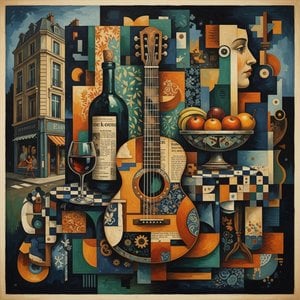
Vlado Martek: Sculpting Silence into Vibrant Collage
Vlado Martek (born 1951) stands as a singular figure in Croatian visual art, recognized for his distinctive approach to translating the essence of poetry into arresting mixed media compositions. Rather than simply depicting verses on canvas, Martek delves deeper—he actively interrogates and reimagines them through layers of texture, image, and deliberate disruption. His artistic philosophy centers around transforming words into tangible experiences, a concept beautifully encapsulated in his mantra: “Art as Burden.”
### Early Life & Artistic Formation
Born in Zagreb, Croatia, Martek’s formative years were steeped in intellectual curiosity fostered by his studies at Zagreb University where he pursued degrees in Philosophy and Literature. This academic grounding profoundly shaped his artistic sensibilities—a sensitivity that wouldn't merely accept words but actively sought to liberate them from their conventional confines. It was during these early explorations that Martek began experimenting with combining visual elements – photography, sketches, drawings – alongside poetic fragments, establishing the foundational principle of his artistic practice: visualizing poetry. He was profoundly influenced by Surrealist artists like René Magritte and Marcel Duchamp, who encouraged him to challenge established aesthetic norms and embrace unconventional materials and methods.
### The Poetic Collage Technique
Martek’s signature technique is arguably his masterful manipulation of collage—a process he elevates beyond mere assemblage to become a form of sculptural storytelling. He meticulously selects images and textual excerpts from poems, often prioritizing fragments that resonate with emotional intensity or paradoxical juxtaposition. These elements aren't simply glued together; they are interwoven, layered, and manipulated through various processes – printing, etching, painting – creating textured surfaces that invite contemplation. The resulting artworks possess a palpable dynamism, mirroring the rhythm and cadence of the original poetry. As Željko Jerman, Martek’s collaborator on early wallpaper-action projects, noted, “The first work I installed in public was a wallpaper-action with the photographer Željko Jerman.” This collaborative effort marked an initial foray into combining visual art with poetic expression—a cornerstone of his artistic trajectory.
### Influences & Artistic Evolution
Martek’s artistic vision draws inspiration from Surrealist explorations of subconscious imagery and Dadaist critiques of societal conventions. Artists like René Magritte and Marcel Duchamp served as crucial touchstones, encouraging Martek to challenge established aesthetic norms and embrace unconventional materials and methods. Over time, his work has evolved beyond purely conceptual collage, incorporating elements of street art—graffiti—and expanding into larger-scale installations that engage with public spaces. This progression reflects a continuing commitment to pushing boundaries and provoking dialogue about the relationship between language and visual representation. He consistently seeks to disrupt conventional artistic practices, mirroring the spirit of Dadaism’s rejection of rational thought.
### Notable Achievements & Legacy
Martek’s artistic output includes several compelling artworks showcased in galleries across Croatia and internationally, notably “The Border 2” and “The Help.” These pieces exemplify his ability to distill complex poetic ideas into visually arresting narratives that resonate with viewers on an emotional level. His work has garnered critical acclaim for its originality and conceptual depth—a testament to Martek’s unwavering dedication to exploring the transformative potential of art as a conduit for conveying profound human experience. He continues to reside in Zagreb, where he serves as a librarian, demonstrating a harmonious blend of intellectual pursuits and artistic expression. His contribution to Croatian visual culture remains significant, cementing his place as an artist who dared to redefine the boundaries between poetry and image.