Stella Scala & Simeone Crispino: Exploring Memory and Transformation Through Sculpture and Photography
Italian art duo Vedovamazzei (Stella Scala & Simeone Crispino) have captivated audiences with their distinctive approach to artistic expression, blending sculpture, painting, installation, and photography into conceptually rich works that delve into themes of history, architecture, and the vibrant heritage of Naples. Born in Naples and Milan respectively, Stella Scala (1964) and Simeone Crispino (1962) embarked on their collaborative journey in 1991, adopting the evocative moniker “vedovamazzei” – a phrase derived from a door plate they discovered serendipitously on a Naples street. This seemingly accidental name encapsulates the duo’s artistic ethos: an embrace of chance encounters and a fascination with unexpected juxtapositions.
Early Influences & Artistic Formation
Stella Scala’s artistic roots lie in a grounding in classical sculpture and architectural studies, fostering an appreciation for meticulous craftsmanship and formal precision. Her formative years were marked by immersion in the grandeur of Naples – a city steeped in history and renowned for its architectural magnificence – which undeniably shaped her aesthetic sensibilities. Simultaneously, Simeone Crispino's background encompasses photography and experimental filmmaking, equipping him with skills in visual storytelling and manipulating perception. These disparate influences converge within Vedovamazzei’s oeuvre, resulting in artworks that simultaneously honor tradition while pushing boundaries of creative exploration. They represent a conscious effort to synthesize seemingly antithetical disciplines—the rigor of sculptural form and the dynamism of photographic image—creating a dialogue between permanence and ephemerality.
The Vedovamazzei Method: Translation and Transformation
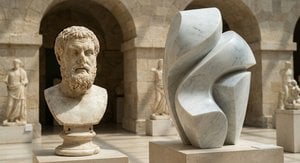
Vedovamazzei’s signature technique revolves around what they term “translation,” characterized by a deliberate layering of media and conceptual interventions. Initially, the duo undertakes a meticulous reproduction of historical pictorial works onto sheets of paper using photographic techniques—a process that seeks to capture not merely visual likeness but also the essence of artistic expression. This step introduces an element of subjective interpretation and disrupts the idealized representation inherent in the original artwork. Subsequently, Vedovamazzei invite children between six and twelve years old to recreate these images from memory – a transformative act that underscores the role of perception in shaping our understanding of art history. Finally, Vedovamazzei transform these childlike drawings into large-scale sculptures or translate them into photographic prints, completing a circuitous journey that highlights the complexities of artistic creation and reception. This method serves as a powerful critique of visual culture, questioning notions of authorship and emphasizing the importance of reimagining familiar narratives through fresh perspectives.
Notable Exhibitions & Recognition
Vedovamazzei’s work has garnered international acclaim, appearing in prestigious venues such as Magazzino d’arte moderna in Rome, Piazza Alighiero Boetti in Rome, BienNoLo in Milan, and Galerie Fucares in Madrid. Their piece *Abbronzatissimi*, featuring reproductions of Rembrandt self-portraits executed by children, was particularly lauded for its conceptual depth and artistic innovation. Furthermore, their installation *Nave Emmet Native Amer* at Dublin Contemporary 2011 garnered critical attention for its exploration of themes related to death penalty information centre and the role of art in confronting societal issues. Their ongoing collaborations with institutions like Siena Pellegrinaio hall and Cosmo Trastevere solidify Vedovamazzei’s position as prominent figures within contemporary artistic discourse.
Recurring Themes & Conceptual Frameworks
Vedovamazzei consistently grapple with concepts of memory, transformation, and the interplay between visual representation and subjective experience. Their artworks frequently employ humorously ironic juxtapositions—such as translating a film into sculpture or repurposing flawed objects—to expose contradictions within cultural narratives. They challenge viewers to reconsider established hierarchies of value and to question the very nature of perception itself. The duo’s meticulous attention to detail, combined with their willingness to experiment across diverse media, distinguishes Vedovamazzei's artistic practice as a distinctive contribution to contemporary art history. Their work reflects a profound engagement with philosophical ideas—particularly those articulated by Jacques Rancière regarding “the partition of the sensible”—demonstrating a commitment to redefining aesthetic experience and asserting the transformative potential of visual art.