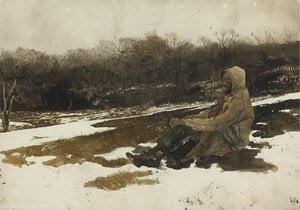
Andrew Wyeth, 1917 – 2009

Andrew Wyeth Paintings: The 61 Most Famous Works, Ranked

Andrew Wyeth's most famous painting is Il Mondo di Christina (1948), in the Museum of Modern Art, New York City. With Amanti (1981) and Campi Invernali (1942), it completes the three works everyone recognises. Our catalogue lists 61 works by Andrew Wyeth; the 61 below are the ones the world looks at most, each with its year, the museum that holds it and why it matters.

Ranked by our popularity score, which combines the searches, visits and orders for each work. Updated Ottobre 2026.

Portrait of Andrew Wyeth
Andrew Wyeth · 1917 – 2009
Born · died
1917 – 2009, Chadds Ford
Movement
Realismo contemporaneo
Works in our catalogue
61
Most famous
Il Mondo di Christina (1948)
Most works at
Museum of Fine Arts

The 10 most famous Andrew Wyeth paintings

Il Mondo di Christina (1948) by Andrew Wyeth
1

Il Mondo di Christina

1948 · Tempera su tavola · Museum of Modern Art, New York City

Dipinto nel 1948, questa iconica opera di Andrew Wyeth trascende la semplice rappresentazione, trasformandosi in una commovente meditazione sul desiderio, l'isolamento e la condizione umana. Rappresenta una giovane donna, identificata come Anna Christina Olson, sdraiata in un campo, con lo sguardo fisso su una fattoria lontana – una scena intrisa sia di serenità che di struggente nostalgia.

Amanti (1981) by Andrew Wyeth
2

Amanti

1981 · Olio su tela

L'opera intitolata Amanti è stata realizzata dal grande artista americano Andrew Wyeth. Questo specifico pezzo risale all'incirca al 1981 e, secondo la tradizione, il dipinto fu originariamente donato come omaggio alla moglie dell'artista, Betsy.

Campi Invernali (1942) by Andrew Wyeth
3

Campi Invernali

1942 · Tempera su tavola · Whitney Museum of American Art, New York

Nel paesaggio silenzioso e gelido del capolavoro del 1942 di Andrew Newell Wyeth, Campi Invernali, esiste una quiete profonda che trascende la semplice rappresentazione stagionale. Al primo sguardo, lo spettatore si trova di fronte a una scena di bellezza cruda e desolata: un singolo corvo morto riposa tra le erbe alte e disseccate di un campo invernale. Eppure, guardare più da vicino significa entrare in uno spazio meditativo dove i…

Sogno ad occhi aperti (1980) by Andrew Wyeth
4

Sogno ad occhi aperti

1980 · Pittura a olio · Museo dell'Arte del Martello, Los Angeles

Andrew Newell Wyeth, maestro del Regionalismo americano, possedeva l'straordinaria capacità di distillare l'essenza della vita quotidiana in dipinti che risuonano con una profonda intensità emotiva. La sua opera del 1980, "Sogno ad occhi aperti", esemplifica questo talento, offrendo uno sguardo su un mondo privato fatto di contemplazione e sottile desiderio. Il dipinto ritrae una donna, apparentemente persa nei suoi pensieri, adagiata su un letto all'interno di una stanza arredata con…

Grape Wine (1966) by Andrew Wyeth
8

Grape Wine

1966

This striking portrait depicts Willard Snowden, a drifter who lived in the artist’s Pennsylvania studio for several years and sat for several paintings in the mid-1960s. Wyeth used tempera and set him before a featureless background, elements characteristic of Renaissance portraiture—thereby elevating the humble sitter like the nobility typically featured in such paintings. Sensitively rendered at life-size in a palette of russet browns, the portrait is rich with subtle detail,…

Andrew Wyeth, paintings 11 to 61

Snow Flurries (1953) by Andrew Wyeth
#14

Snow Flurries

1953

A hill slopes gently up and away from us, and is painted with a few streaks of white amid a field of earthy ash gray, fawn and rust…

Blubber Island, Maine (1938) by Andrew Wyeth
#15

Blubber Island, Maine

1938

Most often associated with the area of Chadds Ford, Pennsylvania, where the Wyeth family has lived for several generations, Newell Convers Wyeth also had a studio in Port…

Self-Portrait (1940) by Andrew Wyeth
#16

Self-Portrait

1940

Known primarily as an illustrator and muralist, Newell Convers Wyeth was initially trained as a draftsman at the Mechanic

Roaring Reef (1951) by Andrew Wyeth
#17

Roaring Reef

1951 · Smithsonian American Art Museum

In this watercolor on paper, Andrew Wyeth presents Roaring Reef, a work dating to about 1951. The composition focuses on the elemental intersection of landscape, water, and rocks.…

Sandspit (1953) by Andrew Wyeth
#19

Sandspit

1953 · Museum of Fine Arts
The Alchemist (1937) by Andrew Wyeth
#27

The Alchemist

1937 · Istituto di Storia della Scienza

Facing a glowing furnace at left, a bearded alchemist in green with red cap looks at flask of green liquid with young assistant in red singlet; laboratory apparatus…

The subjects Andrew Wyeth painted most

The four subjects that return most often among these masterpieces, with the finest example of each.

Where to see Andrew Wyeth's paintings

The 8 museums that hold the most of the paintings on this page.

Museum City Works by Andrew Wyeth Paintings from this list
Museum of Fine Arts, BostonMuseum of Fine Arts Boston 3 Sandspit, Corner of the Woods, Anna Christina
Brandywine Museum of Art, Delaware CountyBrandywine Museum of Art Delaware County 2 Sallie Curtis McCoy, The Critic
Smithsonian American Art Museum, Washington, D.C.Smithsonian American Art Museum Washington, D.C. 2 Roaring Reef, November First
Museum of Modern Art, New York CityMuseum of Modern Art New York City 1 Il Mondo di Christina
Whitney Museum of American Art, New YorkWhitney Museum of American Art New York 1 Campi Invernali
Museo dell'Arte del Martello, Los AngelesMuseo dell'Arte del Martello Los Angeles 1 Sogno ad occhi aperti
Pennsylvania Academy of Fine Arts, FiladelfiaPennsylvania Academy of Fine Arts Filadelfia 1 Young America
Istituto di Storia della Scienza, FiladelfiaIstituto di Storia della Scienza Filadelfia 1 The Alchemist

Andrew Wyeth's most famous painting of each decade

  1. 1930s
  2. 1940s
    Il Mondo di Christina (1948) by Andrew Wyeth
    #1 of 61

    Il Mondo di Christina

    Age 23 – 32 · Museum of Modern Art

    Dipinto nel 1948, questa iconica opera di Andrew Wyeth trascende la semplice rappresentazione, trasformandosi in una commovente meditazione sul desiderio, l'isolamento e la condizione umana. Rappresenta una giovane…

  3. 1950s
    Snow Flurries (1953) by Andrew Wyeth
    #14 of 61

    Snow Flurries

    Age 33 – 42

    A hill slopes gently up and away from us, and is painted with a few streaks of white amid a field of earthy ash gray, fawn and rust…

  4. 1960s
  5. 1970s
  6. 1980s
    Amanti (1981) by Andrew Wyeth
    #2 of 61

    Amanti

    Age 63 – 72

    L'opera intitolata Amanti è stata realizzata dal grande artista americano Andrew Wyeth. Questo specifico pezzo risale all'incirca al 1981 e, secondo la tradizione, il dipinto fu originariamente donato…

  7. 1990s
    The Critic (1990) by Andrew Wyeth
    #26 of 61

    The Critic

    Age 73 – 82 · Brandywine Museum of Art

Questions about Andrew Wyeth's paintings

What is Andrew Wyeth's most famous painting?Show the answer

Il Mondo di Christina (1948), Museum of Modern Art, New York City. Next come Amanti (1981) and Campi Invernali (1942).

How old was Andrew Wyeth when Il Mondo di Christina was painted?Show the answer

31 years old: Il Mondo di Christina dates from 1948 and Andrew Wyeth was born in 1917.

What are the top 10 paintings by Andrew Wyeth?Show the answer

Il Mondo di Christina, Amanti, Campi Invernali, Sogno ad occhi aperti, Wind from the Sea, Henry Teel, Anna Christina, Grape Wine, Allen (oodie) lynch and Bikini. The ranking above gives the year and the museum of each.

How many paintings did Andrew Wyeth make?Show the answer

Our catalogue lists 61 works by Andrew Wyeth, dated from 1935 to 1990.

Where are Andrew Wyeth's most famous paintings?Show the answer

Most of them are in Museum of Fine Arts (Boston), Brandywine Museum of Art (Delaware County) and Smithsonian American Art Museum (Washington, D.C.). The table above lists the museums one by one.

When did Andrew Wyeth paint the most famous works?Show the answer

In 1950s: 7 of the 61 works on this page date from then, among them Snow Flurries.

What are Andrew Wyeth's earliest and latest famous paintings?Show the answer

The earliest on this page is Sallie Curtis McCoy (1935), the latest The Critic (1990).

What did Andrew Wyeth paint most often?Show the answer

Rural pennsylvania (5), American art (4) and Donna (2), among the 61 works on this page.

What medium did Andrew Wyeth use most?Show the answer

Tempera su tavola: 2 of the 61 works on this page.

Which art movement does Andrew Wyeth belong to?Show the answer

Realismo contemporaneo and Regionalismo americano, as the paintings on this page show.

Which Andrew Wyeth paintings can I see at the Museum of Fine Arts?Show the answer

Sandspit, Corner of the Woods and Anna Christina are among the 3 works on this page held by the Museum of Fine Arts, Boston.

About Andrew Wyeth

Primi Anni e Influenze Familiari

  • Nascita e Background: Andrew Newell Wyeth nacque il 12 luglio 1917 a Chadds Ford, Pennsylvania, da N.C. Wyeth, illustratore, e Carolyn Bockius Wyeth.
  • Famiglia d'Artisti: Crebbe in una famiglia profondamente immersa nell'arte. Suo padre era un illustratore rinomato e diversi dei suoi fratelli intrapresero carriere artistiche. Henriette Wyeth Hurd, Carolyn Wyeth e Nathaniel Wyeth erano tutti artisti di talento.
  • Istruzione Domestica: A causa di una salute cagionevole, Andrew ricevette un'istruzione domestica da suo padre, N.C. Wyeth. Questo favorì un rapporto stretto con il padre e permise uno sviluppo artistico intensamente focalizzato.
  • Sviluppo Artistico Iniziale: Suo padre fu il suo principale istruttore, incoraggiandolo a osservare la natura da vicino e a sviluppare il proprio stile unico. Cominciò a disegnare in tenera età, dimostrando un talento notevole fin dall'inizio.

Stile Artistico e Tecniche

  • Regionalismo: Wyeth è spesso associato al movimento regionalista americano, che enfatizzava le rappresentazioni della campagna americana negli anni '30. Tuttavia, il suo lavoro trascendeva la semplice rappresentazione regionale.
  • Realismo: I suoi dipinti sono caratterizzati da un realismo meticoloso, catturando dettagli e texture con precisione notevole. Si sforzava di ritrarre i soggetti come apparivano nella realtà.
  • Tempera all'Uovo e Acquerello: Wyeth utilizzò principalmente la tempera all'uovo per le sue opere più grandi, un mezzo noto per la sua luminosità e il dettaglio. Impiegò anche frequentemente l'acquerello per studi e schizzi più piccoli.
  • Chiaroscuro: Un aspetto notevole del suo stile è l'uso del chiaroscuro – il contrasto drammatico tra luce e ombra – per creare atmosfera e profondità nei suoi dipinti.

Opere Principali e Temi

  • Christina’s World (1948): Probabilmente la sua opera più famosa, "Christina's World" raffigura una donna che striscia attraverso un campo verso una fattoria. È celebrata per il suo potere emotivo ed esplorazione di temi come l'isolamento, la perseveranza e la condizione umana.
  • Altri Dipinti Notabili: Altre opere significative includono “Distant Thunder,” “The Cliffs," “Herring Cove," "Sledding Hill" e numerosi ritratti e paesaggi che raffigurano la Pennsylvania rurale e le coste del Maine.
  • Temi Ricorrenti: L'arte di Wyeth esplora frequentemente temi di isolamento, memoria, il passare del tempo e la bellezza trovata nella vita quotidiana. I suoi soggetti spesso riflettono un senso di contemplazione silenziosa e introspezione.
  • Modelli e Ispirazioni: Trasse ispirazione dalle persone e dai paesaggi intorno a lui, in particolare da Christina Olson, che divenne un modello frequente, e dall'area di Cushing, nel Maine, dove trascorreva le estati.

Influenze e Legacy

  • Winslow Homer: Wyeth ammirava il lavoro di Winslow Homer, un altro importante pittore americano realista noto per le sue rappresentazioni di soggetti marini e della vita rurale.
  • Henry David Thoreau: Gli scritti di Henry David Thoreau, in particolare la sua enfasi sulla natura e sull'autosufficienza, influenzarono profondamente la filosofia artistica di Wyeth.
  • "The Big Parade" di King Vidor: Attribuì a "The Big Parade" di King Vidor una significativa influenza sulla sua comprensione delle dinamiche familiari e della narrazione attraverso immagini visive.
  • Accoglienza Critica: Sebbene inizialmente accolto con recensioni contrastanti, il lavoro di Wyeth ottenne un'ampia riconoscibilità e plauso nel tempo. Divenne uno degli artisti americani più celebrati del XX secolo.
  • Significato Storico: L'arte di Andrew Wyeth è considerata un contributo significativo al realismo americano, catturando l'essenza della vita rurale ed esplorando temi universali con profonda profondità emotiva. La sua eredità continua a ispirare artisti e affascinare il pubblico in tutto il mondo.

Ultimi Anni e Morte

  • Prolifica Produzione Artistica: Nel corso dei suoi ultimi anni, Wyeth continuò a dipingere prolificamente, esplorando nuovi soggetti e perfezionando le sue tecniche.
  • Riconoscimenti e Premi: Ricevette numerosi premi e onori durante la sua carriera, tra cui la National Medal of Arts nel 1998.
  • Morte: Andrew Wyeth morì il 16 gennaio 2009 nella sua casa a Cushing, Maine, all'età di 91 anni. La sua morte segnò la fine di un'era nell'arte americana.

All 61 works by Andrew Wyeth →