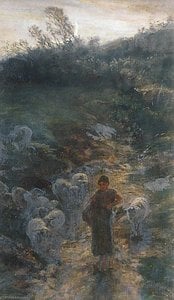
The Soul of the Scottish Landscape: The Life and Legacy of Thomas Hope McLachlan
In the golden age of Victorian landscape painting, few artists possessed the ability to translate the raw, atmospheric essence of the natural world as poignantly as Thomas Hope McLachlan. Born in Edinburgh in 1845, McLachlan emerged not merely as a chronicler of scenery, but as a poet of light and shadow. His early years in Scotland provided him with a profound connection to the rugged beauty of his homeland, an innate fascination that would eventually propel him toward international recognition. His work is characterized by a deep psychological resonance, where every mist-covered glen and crashing wave serves as a vessel for themes of solitude, contemplation, and the eternal communion between humanity and the wild.
The trajectory of McLachlan’s artistic evolution was irrevocably altered during his formative years in Paris in the late 1860s. It was here that he encountered the transformative influence of Jean-François Millet, a master whose dedication to portraying the dignity of everyday life and the fleeting nuances of light left an indelible mark on the young Scot. Under Millet’s tutelage, McLachlan moved away from purely decorative traditions, embracing instead a technique rooted in tonal subtlety and direct observation. This Parisian period instilled in him a lifelong commitment to plein air painting—a practice that demanded an intimate, physical engagement with the environment. Through this lens, he learned to utilize luminous color palettes and meticulous detail to convey profound emotional truths, bridging the gap between mere representation and spiritual expression.
Mastery of Atmosphere and Technique
Upon his return to Scotland in 1873, McLachlan transitioned from a wandering student to a pivotal figure in the nation's artistic community. His appointment as a professor at the Glasgow School of Art allowed him to disseminate his unique blend of Romantic ideals and Impressionistic technique to a new generation of painters. His teaching emphasized the importance of capturing the ephemeral—the way light shifts across a moor or how moisture hangs in the air after a storm. This dedication to the atmospheric qualities of the landscape is perhaps most evident in his celebrated works, such as The Isles of the Sea (1894), where his mastery of oil on canvas creates a breathtaking sense of depth and dimension. In this piece, the viewer is not merely observing waves crashing against rocks; they are drawn into the very power and rhythm of the ocean itself.
McLachlan’s repertoire was as diverse as the landscapes he frequented, ranging from quiet, pastoral scenes to more dramatic, sweeping vistas. His ability to manipulate texture and light allowed him to inhabit various moods:
- The Pastoral and Intimate: Works like Goose Girl demonstrate his ability to find beauty in the quiet, domestic rhythms of rural life, imbuing simple subjects with a sense of dignity and peace.
- The Dramatic and Elemental: In paintings such as The Wind on the Hill and Moorland Scene, he captures the untamed energy of the Scottish highlands, using sweeping compositions to evoke the vastness of the terrain.
- The Maritime and Powerful: His coastal works showcase a sophisticated use of color to depict the churning vitality of the sea, reflecting his deep-seated fascination with the ocean's dual nature of beauty and ferocity.
Historical Significance and Enduring Resonance
Though his life was tragically short, ending in 1897, the impact of Thomas Hope McLachlan on the landscape tradition remains profound. He stood at a critical intersection of art history, blending the Romantic sensibilities of the early 19th century with the burgeoning light-focused innovations of the Impressionist movement. By bringing the lessons of the French masters back to the rugged terrain of Scotland, he helped create a distinct visual language for Scottish landscape art—one that prioritized emotional truth over mere topographical accuracy.
Today, McLachlan’s works reside in prestigious collections such as the Tate and the Guildhall Art Gallery, serving as enduring testaments to his vision. His legacy is found not only in the physical canvases he left behind but in the way he taught us to look at the world: not just as a collection of objects, but as a living, breathing entity capable of reflecting the deepest reaches of the human soul. Through his brush, the landscapes of Scotland are forever imbued with a sense of eternal, quiet majesty.
Domande e risposte
Dove si possono esplorare le opere di Thomas Hope Mclachlan organizzate per colore?
La pagina Indice dei colori di Thomas Hope Mclachlan organizza le opere dell'artista in base al colore.
Posso studiare l'uso del colore di Thomas Hope Mclachlan in tutte le sue opere?
Il profilo cromatico delle opere di Thomas Hope Mclachlan è consultabile nella pagina Profilo Cromatico dell'Artista dell'artista.
Dove si possono trovare le opere di Thomas Hope Mclachlan raggruppate per tecnica?
La pagina Per tecnica raggruppa le opere di Thomas Hope Mclachlan per tecnica.