Thomas Davies FRSL FLS: Pioneer of Military Watercolor and Ornithological Observation
Thomas Davies (c. 1737 – 16 March 1812) stands as a singular figure in British art history—a soldier, an artist, and a naturalist whose intertwined pursuits yielded remarkable contributions to both visual representation and scientific understanding of the natural world. Born in Shooter’s Hill, London, Davies ascended through the ranks of the Royal Artillery, achieving the distinction of Lieutenant-General, yet his legacy transcends military service; it resides primarily in his pioneering watercolors documenting pivotal moments in British colonial expansion and his groundbreaking ornithological studies that cemented his place as the first to accurately depict and describe the magnificent lyrebird.
Davies’s artistic journey began with a foundational education at Eton College, where he honed his mathematical skills alongside an innate talent for drawing—skills that would prove indispensable for his subsequent military career and artistic endeavors. His enrollment at Woolwich Royal Military Academy in 1755 initiated a disciplined regimen focused on topographical drawing, equipping him with the technical precision required to transform battlefield observations into meticulously rendered visual records. This dedication to accuracy reflected not only a commitment to duty but also an unwavering belief in the power of art to faithfully capture reality.
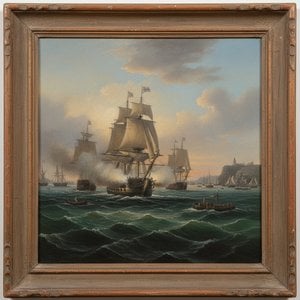
The Napoleonic Wars served as the crucible for Davies’s artistic maturation and military prowess. He participated actively in campaigns spanning Europe and North America, demonstrating adaptability and resilience amidst turbulent times. His involvement in the Seven Years' War established him as a respected officer—a reputation bolstered by his skillful command of Fort Knyphausen during the siege of New York City and courageous defense of Gibraltar against Napoleon’s forces. Yet it was during the American Revolutionary War that Davies truly blossomed as an artist, producing breathtaking watercolors capturing pivotal battles and documenting naval engagements with unparalleled detail and sensitivity. These works stand as enduring symbols of British determination and artistic excellence.
Davies's artistic style distinguishes itself through a harmonious blend of meticulous realism and expressive nuance. He eschewed idealized representations in favor of portraying the immediacy of military life—prioritizing accuracy alongside compositional considerations that conveyed both grandeur and drama. His watercolors—characterized by crisp lines and subtle tonal gradations—were executed with remarkable patience and precision, reflecting his profound respect for observation and artistic craftmanship. Notably, Davies’s work anticipated the stylistic developments of Romanticism, embracing a looser brushstroke and heightened color palette to convey emotion alongside factual detail.
However, Davies's legacy extends far beyond the realm of military art; it resides principally in his transformative contribution to ornithology. Driven by an insatiable curiosity for the natural world, he embarked on an expedition to Australia in 1800—a journey that culminated in the discovery and exquisitely documented illustration of the superb lyrebird (Loureiro cristatus). This groundbreaking achievement solidified Davies’s position as the first scientist to comprehensively record this iconic species—demonstrating his unwavering belief in the interconnectedness between art and science. His watercolor rendering captured the bird's extraordinary vocalizations and plumage with unprecedented accuracy, establishing him as a pioneer of scientific illustration and securing his place among Britain’s most celebrated naturalists.
Davies’s paintings were initially overlooked by the public eye until a significant auction in 1953—featuring a collection from the Earl of Derby’s library—brought his oeuvre to wider recognition. Subsequent exhibitions at the National Gallery of Canada further illuminated his artistic achievements and underscored his enduring influence on British art history. Today, Thomas Davies is remembered not merely as a military officer but as a visionary whose artistic endeavors simultaneously documented historical events and celebrated the sublime beauty of the natural world—a testament to the transformative power of intellectual curiosity and artistic dedication.
Sources:
- Wikipedia:
- Dictionary of Canadian Biography: