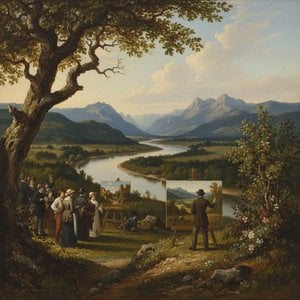
Théophile Emmanuel Duverger: A Painter of Rural Life and Quiet Observation
Théophile Emmanuel Duverger (17 March 1821, in Bordeaux – 25 August 1898, in Écouen) was a French painter who emerged from humble beginnings to become a respected figure within the Parisian Salon landscape. Unlike many of his contemporaries preoccupied with grand narratives and dramatic events, Duverger’s artistic vision centered on capturing the everyday realities of rural France – scenes of labor, family life, and simple pleasures—a stylistic choice that cemented his place as one of the foremost practitioners of genre painting in the latter half of the nineteenth century. His canvases are imbued with a quiet dignity and contemplative spirit—a reflection of his belief that art should serve as a conduit for understanding human experience.
Early Life & Training
Born in Bordeaux, Duverger’s artistic journey began without formal instruction. Instead, he honed his skills through meticulous observation of nature and by studying the works of masters such as Gustave Courbet and Jean-François Millet, artists who championed realism and depicted peasant life with unflinching honesty. This autodidactic approach profoundly shaped his aesthetic sensibilities. He absorbed the lessons of these influential figures—particularly Millet’s ability to convey emotion through detailed depictions of rural labor—and diligently practiced his craft, prioritizing accuracy over idealized beauty. Like many artists of his time, Duverger eschewed academic conventions in favor of a more direct engagement with the natural world and human experience.
Salon Exhibitions & Recognition
Duverger’s artistic career gained momentum through participation in the Paris Salon from 1846 onwards. He swiftly established himself as a portraitist specializing in depictions of women, capturing their likenesses with remarkable sensitivity and detail. However, he soon transitioned to genre scenes—particularly those portraying rural laborers and families—where his talent shone brightest. His meticulous attention to texture and tonal variation—a hallmark of Impressionism—allowed him to convey the atmosphere of everyday life with profound subtlety. He received a third class medal at the Salon of 1861, followed by a reminder in 1863, and subsequently secured another medal in 1865. These accolades underscored his growing reputation within the Parisian art world and validated his commitment to portraying the lives of ordinary people with dignity and compassion.
Notable Achievements & Awards
Perhaps his most enduring legacy resides in ‘The Worker and His Children,’ commissioned by the state for the Musée du Luxembourg (now Musée d’Orsay). This monumental canvas exemplifies Duverger's masterful technique—characterized by subtle tonal gradations and a profound understanding of light—and remains an iconic representation of Victorian social realism. The painting depicts a family engaged in agricultural labor, capturing the hardships endured by rural workers with unflinching honesty yet imbued with a sense of warmth and familial affection. It stands as a testament to Duverger’s ability to transform observation into art—to distill complex emotions and experiences into visually arresting images that continue to resonate with audiences today. He was awarded an honourable mention at the Salon of 1863, recognizing his dedication to portraying human experience with empathy and nuance.
Influences & Artistic Style
Duverger’s artistic style was undeniably influenced by the Impressionists, albeit he maintained a steadfast commitment to realism. Like Millet, he sought to convey emotion through meticulous observation and detailed rendering, prioritizing accuracy over idealized beauty. His canvases are imbued with a quiet dignity and contemplative spirit—a reflection of his belief that art should serve as a conduit for understanding human experience. He absorbed the lessons of Courbet’s unflinching portrayal of social realities—particularly his depictions of peasant life—and diligently practiced his craft, prioritizing accuracy over idealized beauty. This stylistic choice distinguished him from many of his contemporaries who favored grand narratives and theatrical compositions.
Legacy & Significance
Duverger’s contribution to French painting is significant not only for his stylistic innovations but also for his unwavering focus on portraying the lives of ordinary people. He championed a humanist aesthetic that prioritized empathy and social commentary, aligning him with the broader artistic currents of his time. Today, Duverger's paintings continue to resonate with audiences captivated by their evocative depictions of rural France and their understated beauty—testaments to the enduring power of observation and artistic integrity. His work serves as an inspiration for artists seeking to capture the essence of human experience through meticulous detail and tonal subtlety—a legacy that ensures his place among the most respected practitioners of genre painting in nineteenth-century France.