Stasys Ušinskas: A Pioneer of Lithuanian Modernism
Stasys Ušinskas (20 July 1905 – 14 June 1974) stands as a singular figure in Lithuanian art history—a “father of Lithuanian stained glass art,” as he’s rightfully recognized—whose multifaceted talent spanned painting, scenography, animation, puppetry, and decorative glassworks. Born in Pakruojis, Lithuania, to Juozas Ušinskas, a stonebreaker, and Sofija Ušinskaitė, his early life instilled within him a profound appreciation for craftsmanship and observation of the natural world—influences that would permeate his artistic vision throughout his prolific career. His formative years included time spent in the United States before returning to Lithuania in 1914, where he pursued formal education at Šiauliai Gymnasium, laying the groundwork for his subsequent studies at Kaunas Art School and later at Académie Julian in Paris.Early Life and Education
Stasys Ušinskas’s childhood in Pakruojis nurtured a deep connection to Lithuanian traditions and landscapes—a formative experience that would profoundly shape his artistic sensibility. Between 1908 (1909?) and 1914, the family resided in the United States, providing him with exposure to diverse cultural perspectives. In 1914, he returned to Lithuania and graduated from Šiauliai Gymnasium in 1925, honing his intellectual curiosity alongside a burgeoning artistic inclination. His subsequent studies at Kaunas Art School under Justinas Vienožinskis solidified his grounding in classical painting techniques while simultaneously introducing him to the avant-garde currents circulating within Lithuanian art circles. Notably, Vienožinskis encouraged Ušinskas’s exploration of experimental approaches—a pivotal moment that propelled him toward embracing the transformative potential of Parisian artistic training.Parisian Training and Artistic Influences
Paris proved instrumental in shaping Ušinskas’s artistic worldview. The Académie Julian exposed him to the burgeoning modernist movement—particularly Cubism and Art Deco—introducing him to influential artists like Henri-Marcel Magne, whose lectures instilled within him a nuanced understanding of theatrical design and visual storytelling. This exposure fostered a collaborative spirit, encouraging him to engage with Aleksandra Ekster, who championed experimentation and pushed him toward exploring new artistic mediums. Ekster’s unwavering belief in innovation profoundly impacted Ušinskas's creative process—inspiring him to transcend conventional boundaries and embrace unconventional techniques. Her encouragement led him to delve into the captivating realm of puppetry, recognizing its capacity as a powerful tool for conveying complex narratives and eliciting emotional responses from audiences—a fascination that would define much of his later artistic endeavors. Magne’s lectures on theatrical design specifically emphasized the importance of visual harmony and dramatic impact—principles that Ušinskas diligently incorporated into his scenographic creations.A Diverse Artistic Output: Painting & Stained Glass
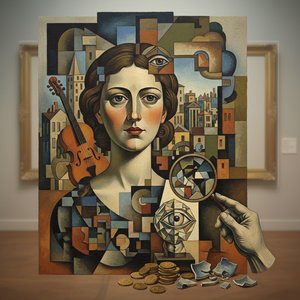
Ušinskas's artistic output was remarkably varied, reflecting his intellectual curiosity and unwavering commitment to artistic exploration. His paintings exemplify modernist principles—characterized by geometric abstraction, flattened perspectives, and bold color palettes—often mirroring the grandeur of Lithuanian landscapes and infused with humanist ideals. “The Bather,” completed in 1931, stands as a testament to Ušinskas’s mastery of Cubist fragmentation and Art Deco ornamentation—a stylistic fusion that embodies the spirit of Lithuanian Modernism. The artwork's muted tones and simplified forms convey a sense of serene contemplation—a characteristic aesthetic hallmark of his oeuvre. However, Ušinskas’s legacy transcends painting; he revolutionized Lithuanian stained glass art, establishing it as a distinct artistic discipline and elevating its aesthetic standards. His meticulous craftsmanship combined with innovative compositional techniques—drawing inspiration from Cubist fragmentation and Art Deco ornamentation—created breathtaking artworks that continue to captivate viewers today. The Central State Archives of Lithuania recognized his contribution as an object of documentary heritage of national significance, cementing his place in Lithuanian cultural history.Animation & Puppetry: Expanding Artistic Horizons
Beyond painting and stained glass, Ušinskas demonstrated exceptional versatility by venturing into animation and puppetry—fields where he achieved unparalleled renown. He conceived and executed several animated films—including “The Dream of the Fatty”—that showcased his mastery of visual storytelling and experimental filmmaking techniques. These films pushed the boundaries of cinematic expression, incorporating innovative camera angles and stylized movements to convey profound emotional narratives. Furthermore, Ušinskas’s puppet theatre productions were equally ambitious, blending theatrical performance with intricate marionette craftsmanship and imaginative narratives rooted in folklore and mythology. The Kaunas State Puppet Theatre proudly displays Ušinskas’s puppets—a tangible embodiment of his artistic vision—demonstrating the enduring legacy of Lithuanian puppetry tradition. His pioneering work as a puppeteer established him as a visionary artist who championed the transformative potential of collaborative storytelling—a contribution that continues to inspire artists and educators alike.Domande e risposte
Dove si trovano le opere di Stasys Ušinskas mappate per soggetto?
Le opere di Stasys Ušinskas possono essere esplorate per soggetto nella pagina Atlante dei soggetti dell'artista.
In quali periodi è suddivisa la carriera di Stasys Ušinskas?
Un resoconto cronologico delle opere di Stasys Ušinskas è disponibile nella pagina Cronologia dell'artista, dove le opere sono presentate nell'ordine di creazione, capitolo dopo capitolo.
Come posso trovare le opere di Stasys Ušinskas su un tema specifico?
Le opere di Stasys Ušinskas possono essere esplorate tramite parole chiave nella pagina Per parole chiave dell'artista. Ogni parola chiave raggruppa le opere correlate.