Samir Al-Sayegh: Bridging Tradition and Innovation Through Calligraphy
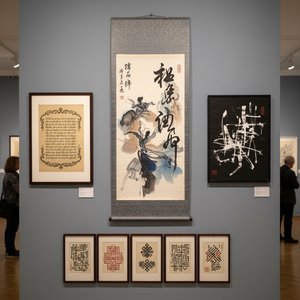
Born in Beirut, Lebanon in 1945, Samir Al-Sayegh is a multifaceted artist whose career spans decades of critical acclaim, prolific authorship, poetic exploration, and captivating visual art. His journey began with an early fascination for calligraphy—a passion ignited at the age of twelve when his teacher recognized his exceptional handwriting skills. This formative experience propelled him toward a deep immersion in Arabic calligraphy, nurtured by his studies at Saint Savior Convent in Joun, Lebanon, where he gained access to rare and ancient Arabic books, shaping his artistic vision profoundly. These texts instilled within him not merely technical proficiency but also an understanding of the visual language of Islam—a language capable of conveying complex ideas with remarkable grace and precision. The pursuit of knowledge continued at École des Beaux-Arts in Paris, where Al-Sayegh broadened his horizons beyond Eastern aesthetics by immersing himself in Western artistic traditions. This dual influence fostered a unique perspective that would inform his subsequent endeavors as both artist and writer. Returning to Lebanon after completing his studies, he established himself as a respected journalist for Lissan al-Hal newspaper and Finoun Arabia—roles that provided him with invaluable exposure within the Middle Eastern art world and served as conduits for disseminating his artistic ideas. His literary debut arrived in 1980 with “Maqam al-Qaws wa Ahwal al-Sahm,” a collection of poems that immediately distinguished itself from conventional poetic forms. Al-Sayegh deliberately eschewed established linguistic conventions, prioritizing instead masterful manipulation of imagery and symbolism—techniques honed by his calligraphy training and reinforced by his scholarly background. Throughout the 1980s, he consistently presented exhibitions alongside critical analyses of his calligraphic works, meticulously documenting his artistic evolution and cementing his reputation as a trailblazer in contemporary calligraphy. He relentlessly explored the expressive potential of this medium, pushing its boundaries and redefining what was possible within visual poetry. Al-Sayegh’s dedication to preserving and innovating upon traditional Arabic calligraphy is evident in every piece he creates—a testament to his profound respect for heritage combined with an unwavering desire to communicate ideas powerfully. His work has garnered international recognition, notably through collaborations with institutions like the British Museum where he showcased “He 1,” “Peace 3” and “He 2”—demonstrating his commitment to sharing his artistic vision globally. He stands as a beacon of artistic excellence—a true master calligrapher who has transformed letters into instruments of profound expressive power, leaving an indelible mark on the landscape of modern art.- Notable artworks: “He 1”, “Peace 3”, “He 2”
- Influenced by: Islamic Art
- Places of Influence: Saint Savior Convent in Joun, Lebanon