Early Life and Academic Foundations
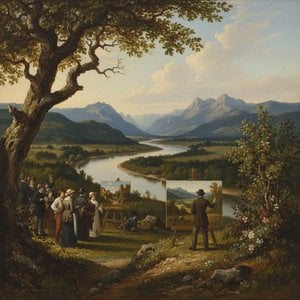
Robert Russ, born in Vienna in 1847, emerged from a family deeply rooted in the artistic traditions of Austria. Both his father and brother were accomplished painters, fostering an environment where creativity wasn’t merely encouraged but lived as a fundamental aspect of daily life. This familial influence undoubtedly played a pivotal role in steering young Robert towards a career dedicated to capturing the beauty of the world around him. In 1861, he enrolled at the prestigious Vienna Academy of Fine Arts, specifically joining the landscape class led by Albert Zimmermann – a figure known as the “mountain specialist.” Zimmermann’s tutelage proved formative, instilling in Russ a meticulous approach to depicting natural environments and an appreciation for the subtleties of light and atmosphere. Among his fellow students were notable artists like Emil Jakob Schindler, Eugen Jettel, and Rudolf Ribarz, creating a vibrant artistic community that would shape his early development.
A Rising Star: Exhibitions and Commissions
Russ quickly distinguished himself as a promising talent. By 1871, he had already begun teaching landscape painting at the Vienna Academy, a testament to his burgeoning skill and recognition within the art world. The year 1873 marked a significant milestone with his inclusion in the Vienna World Exhibition, where five of his paintings were showcased, garnering attention from critics and collectors alike. This success led to a series of prestigious commissions, primarily focused on decorating buildings along the iconic Ring avenue in Vienna – a project that allowed him to hone his skills on a grand scale and establish himself as a sought-after artist. These early works often featured architectural views and urban genre scenes, demonstrating a versatility that would become characteristic of his oeuvre.
The Allure of South Tyrol and Impressionistic Influences
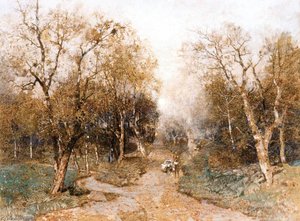
The 1880s and 1890s witnessed Russ achieving international acclaim, punctuated by numerous awards recognizing his artistic merit. However, it was during the mid-1890s that his artistic focus began to shift dramatically. He found himself increasingly drawn to the breathtaking landscapes of South Tyrol (Südtirol) and the serene beauty of Lake Garda in Italy. These regions became a primary source of inspiration, providing him with an abundance of motifs that he would explore throughout the remainder of his career. His style underwent a subtle but significant evolution during this period, influenced by the burgeoning Impressionistic movement. While remaining committed to optical realism, Russ began to prioritize capturing the fleeting effects of light and atmosphere on surfaces, resulting in paintings characterized by a free, sketchy technique and a heightened sense of immediacy.
Legacy and Historical Significance
Robert Russ’s impact on Austrian landscape painting during the late 19th century is undeniable. He wasn't merely replicating scenes; he was interpreting them through a lens that blended meticulous observation with an emerging sensitivity to atmospheric nuances. His works offer a captivating glimpse into the European landscapes of his time, particularly those of Austria and Italy. His paintings are celebrated for their ability to evoke a sense of place, transporting viewers to sun-drenched meadows, bustling marketplaces, and dramatic mountain vistas. Russ’s dedication to capturing the optical reality while embracing Impressionistic techniques created a unique style that resonated with audiences then and continues to captivate art enthusiasts today. He left behind a substantial body of work that stands as a testament to his skill, vision, and enduring passion for the natural world. His influence can be seen in the works of subsequent generations of Austrian landscape painters who sought to balance realism with an expressive interpretation of light and atmosphere.
Major Themes and Techniques
- Landscape Painting: Russ is primarily known for his landscapes, particularly those depicting the mountains and countryside of Austria and Italy.
- Urban Genre Scenes: Early in his career, he also painted scenes of everyday life in Vienna and other European cities.
- Architectural Views: Commissions led him to create detailed depictions of buildings and architectural landmarks.
- Atmospheric Perspective: A key element of his style is the use of atmospheric perspective to create a sense of depth and realism.
- Sketchy Brushwork: Influenced by Impressionism, Russ adopted a looser, more expressive brushstroke in his later works.