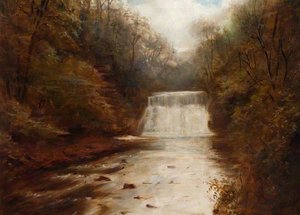
A Visionary of Ayrshire Landscapes
Robert Purves Bell (1841–1931) stands as a profound chronicler of the Scottish spirit, an artist whose brush breathed life into the rugged textures and atmospheric mysteries of the Ayrshire countryside. Born in Edinburgh, Bell possessed an innate sensitivity to the shifting moods of the natural world, a gift that would eventually establish him as one of the most evocative landscape painters of his era. His artistic journey was not merely a pursuit of aesthetic beauty but a deep, meditative engagement with the land itself, capturing the dramatic interplay of light and shadow that defines the Scottish Highlands and Lowlands.
The foundations of Bell’s mastery were laid during his rigorous training at the Royal Scottish Academy, which he entered in 1863. Immersed in the prevailing currents of Academic realism and the burgeoning influence of Impressionism, he developed a disciplined technique that balanced scientific precision with expressive emotion. This duality allowed him to move beyond simple representation, seeking instead to capture the very essence of his subjects. Supported by the stability provided by his father, a successful solicitor, Bell was afforded the rare luxury of total devotion to his craft, allowing him to refine a method of layering thin, luminous glazes of oil paint that gave his canvases an almost ethereal glow.
The Majesty of Calderwood and Beyond
Bell’s most enduring legacy lies in his breathtaking documentation of the Ayrshire region, specifically the hauntingly beautiful environs of Calderwood Castle. To look upon his depictions of this landmark is to experience the palpable history etched into its stone walls. He did not merely paint a structure; he painted the atmosphere surrounding it—the turbulent winds that sweep across the craggy hills and the way the light dances over Loch Greggory. His work serves as a visual poem to the permanence of nature contrasted with the fleeting moments of weather and time.
Beyond the grand scale of his landscapes, Bell demonstrated a remarkable versatility in his handling of subject matter. While he is celebrated for his sweeping vistas, his ability to capture intimate details and human presence added a layer of vitality to his oeuvre. His technique was particularly evident in works such as Broken Cross, Hamilton, where he utilized vibrant colors and intricate details to depict the rhythmic pulse of daily life within a small town. Whether portraying the quiet dignity of a portrait, such as his Portrait of a Gentleman, or the bustling energy of a village street, Bell maintained a consistent commitment to capturing the soul of his subject through meticulous observation.
Legacy and Artistic Significance
The historical significance of Robert Purves Bell extends far beyond the borders of Scotland. As a champion of Victorian plein air painting, he helped bridge the gap between traditional academic rigor and the more spontaneous, light-focused approaches of the modern era. His work remains a vital record of a landscape and a way of life that have since been transformed by time. Through his canvases, the viewer is invited to step into a nineteenth-century Scotland characterized by both its rugged grandeur and its quiet, pastoral grace.
Today, Bell’s contributions are preserved in esteemed collections, ensuring that his vision of the Scottish landscape continues to inspire awe. His life's work stands as a testament to the power of observation and the enduring beauty of the natural world, leaving behind a legacy defined by:
- Masterful Technique: The use of delicate glazes to achieve luminous, atmospheric effects.
- Regional Devotion: An unparalleled documentation of the Ayrshire landscape and Calderwood Castle.
- Versatility: A seamless transition between grand-scale landscapes, intimate portraits, and lively genre scenes.
- Historical Resonance: Capturing the shifting light and spirit of the Victorian era through a lens of profound connection to nature.