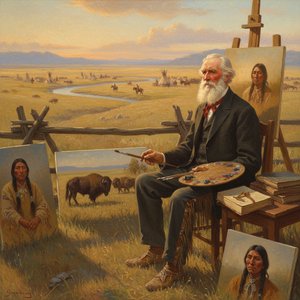
Robert Henry Thurston (1839 – 1903): Pioneer of Mechanical Engineering and Artistic Illustration
Robert Henry Thurston, born in Providence, Rhode Island on October 25, 1839, stands as a pivotal figure in the annals of American engineering history—and unexpectedly, also possessed a remarkable talent for artistic illustration. His legacy transcends mere technical prowess; he embodies the spirit of innovation and meticulous observation that defined the Industrial Revolution era.
Early Life and Education
Thurston’s formative years were steeped in the industrial landscape of Rhode Island, where his father operated a textile mill. This early exposure instilled within him a fascination with machinery and propelled him toward academic pursuits at Brown University, culminating in a degree in engineering in 1859. He continued his studies at Cornell University, establishing himself as a leading voice in the burgeoning field of mechanical engineering.
Military Service and Academic Career
Thurston’s commitment to service extended beyond academia. He enlisted in the United States Navy in 1861 during the Civil War, serving valiantly on several vessels—including the USS Winona and USS Hartford—participating actively in crucial naval engagements like Port Royal and Charleston. His experience honed his analytical skills and deepened his understanding of practical engineering challenges. Following the war, he transitioned to Annapolis Naval Academy as an assistant professor, furthering his dedication to educating future generations of engineers and scientists.
Stevens Institute of Technology: Shaping Mechanical Engineering
A defining moment in Thurston’s career arrived in 1871 when he was appointed the inaugural professor of mechanical engineering at Stevens Institute of Technology—a position he held until his retirement in 1885. Recognizing the importance of hands-on experimentation, he championed innovative teaching methods and conducted groundbreaking research into steam engine efficiency and material properties. Notably, Thurston’s meticulous investigations into boiler explosions yielded invaluable insights that significantly advanced safety standards within the industry.
Contributions to Scientific Advancement
Beyond his institutional role, Thurston actively engaged in scientific endeavors. He served on the United States Commission for the Vienna Exposition of 1873, meticulously documenting and evaluating technological advancements from around the globe—a task he undertook with unwavering dedication. His detailed reports on exhibitors’ innovations and materials showcased a profound respect for precision and accuracy. Furthermore, his involvement in establishing the American Society of Mechanical Engineers cemented his reputation as a champion of engineering excellence.
Artistic Legacy: Detailed Engravings and Technical Illustrations
While primarily recognized for his engineering achievements, Thurston possessed an undeniable artistic inclination—evident in his captivating steam machine engravings. These drawings weren’t merely representations of machinery; they were imbued with a meticulous attention to detail that captured the essence of technological innovation. His illustrations served as invaluable tools for disseminating knowledge and inspiring future engineers. He produced several publications on materials science and engineering, which contributed significantly to the advancement of scientific understanding during his lifetime.
Robert Henry Thurston passed away peacefully in Ithaca, New York, on October 25, 1903, leaving behind a legacy that continues to resonate within the field of mechanical engineering—and reminding us that brilliance can flourish across disciplines.