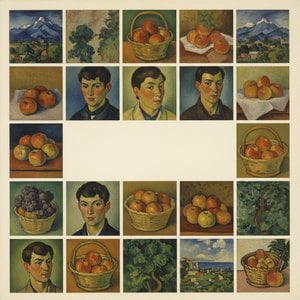
Raymond Guerrier: A Provençal Master of Light and Landscape
Raymond Guerrier, a name perhaps less familiar than some of his contemporaries of the School of Paris, nevertheless represents a quietly powerful voice in 20th-century French art. Born in Paris in 1920 and passing away in Avignon in 2002, Guerrier’s journey was one of deliberate self-education, culminating in a distinctive style deeply rooted in the landscapes and light of Provence – a region he would ultimately call home. His work, often characterized by its luminous quality and evocative depictions of rural life, deserves greater recognition as a significant contributor to the evolving artistic landscape of his time.
Early Influences and Artistic Beginnings
Guerrier’s artistic path wasn't paved with formal training; instead, it began with an intense engagement with the art world from a young age. He spent his formative years frequenting Parisian museums, immersing himself in the works of masters like Goya and Cézanne – artists whose mastery of light, color, and form profoundly shaped his own approach. This independent study, coupled with a period working as a photoengraver to support himself, provided him with a practical understanding of visual techniques while simultaneously fueling his artistic aspirations. His initial exhibitions at the Salon d’Automne and Salon des Indépendants in 1947 marked a crucial first step, establishing his presence within the Parisian art scene and laying the groundwork for his future development. The recognition he received during a group exhibition in 1952 – including a prestigious prize – ultimately allowed him to dedicate himself fully to painting, a decision that proved transformative.
The Provençal Shift: Light, Color, and New Horizons
A pivotal moment in Guerrier’s career arrived with his move to Eygalières in the South of France in 1955. This relocation wasn't merely a geographical change; it represented a fundamental shift in his artistic vision. The intense Provençal light – its vibrant yellows, oranges, and blues – became the defining element of his palette and subject matter. He began to capture the essence of the region’s landscapes: the rugged Alpilles mountains, the rolling vineyards, and the sun-drenched villages. His paintings moved away from the often muted tones of Parisian art towards a brighter, more optimistic aesthetic. This period saw him exploring themes of rural life, capturing the rhythms of daily existence – farmers tending their fields, shepherds watching over their flocks, and the simple beauty of the Provençal countryside. His travels throughout Spain, Greece, Morocco, Jordan, and Israel further enriched his artistic vocabulary, introducing new colors, textures, and perspectives that he seamlessly integrated into his work.
Style and Technique: A Synthesis of Observation and Emotion
Guerrier’s style can be described as a synthesis of observation and emotion. While rooted in the traditions of Post-Impressionism and Cubism – evident in his use of fragmented forms and bold color choices – his work transcends mere imitation. He possessed an extraordinary ability to capture the *feeling* of a place, conveying not just its visual appearance but also the atmosphere and spirit of Provence. His brushwork is often loose and expressive, creating a sense of movement and vitality. He favored a limited palette, carefully selecting colors to evoke specific moods and enhance the luminosity of his scenes. The influence of Goya, particularly in his use of dramatic lighting and emotional intensity, is subtly present throughout his oeuvre.
Legacy and Recognition
Raymond Guerrier’s work gained international recognition during the 1960s and 70s, with exhibitions held in Geneva, Venezuela, and Buenos Aires. His paintings are now housed in prominent museums across Europe, including the Musée National d'Art Moderne in Paris, Poitiers, Marseille, Pau, Calais, Le Havre, and London. He was awarded the title of Chevalier des Arts et Lettres, a testament to his contribution to French culture. While perhaps not as widely celebrated as some of his contemporaries, Raymond Guerrier’s legacy lies in his quietly powerful depictions of Provence – landscapes imbued with light, color, and an enduring sense of beauty. His work stands as a poignant reminder that true artistic vision often emerges from independent exploration and a deep connection to one's surroundings.
A cura del team editoriale di WahooArt.com
Quiz d'arte
Per ogni domanda è presente una sola risposta corretta.
Domanda 1:
Raymond Guerrier primarily focused on painting landscapes and still lifes. Where did he initially develop his artistic skills?
Domanda 2:
Which event significantly propelled Raymond Guerrier to dedicate himself fully to painting?
Domanda 3:
During his travels, particularly in Spain and North Africa, what color palette shift did Raymond Guerrier observe in his work?
Domanda 4:
Which institution holds a significant collection of Raymond Guerrier's paintings?
Domanda 5:
Raymond Guerrier's early exhibitions took place at which two prominent Parisian salons?
Explore the rich history of landscape art with WahooArt. Discover renowned artists, movements like Impressionism & Romanticism, and expert guidance for collecting timeless pieces. Find your perfect serene escape today!
Explore the captivating world of Bernard Cathelin, a master of French Poetic Realism. Discover his stunning still lifes & landscapes, and learn about his legacy with WahooArt.
Esplora i 25 capolavori di Paul Cézanne, il maestro dell'impressionismo e post-impressionismo. Scopri la storia, le tecniche e i colori iconici dietro opere come 'Le grandi bagnanti' e 'Mont Sainte-Victoire'. Trova riproduzioni artistiche di alta qualità per decorare la tua casa su WahooArt.com.