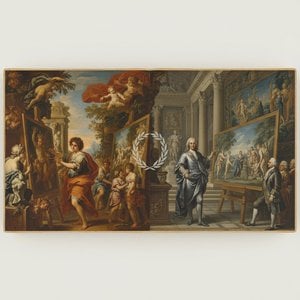
Pietro Dandini (1646–1712): Florentine Baroque’s Delicate Hand
Pietro Dandini stands as a pivotal figure in the Florentine Baroque, embodying its blend of grandeur and refined elegance—a legacy firmly rooted in his familial artistic lineage. Born in Florence around 1646, he emerged from the influential Dandini family, where Vincenzo Dandini served as his father, and Cesare Dandini, his uncle, established a tradition of monumental painting that profoundly shaped Pietro’s artistic vision. This upbringing instilled within him not merely technical skill but also an understanding of artistic patronage and the importance of conveying spiritual depth through visual representation.
His formative years were spent absorbing the stylistic precepts of Vincenzo Dandini, who championed a style characterized by clarity, precision, and masterful draughtsmanship—a cornerstone of Florentine Baroque aesthetics. Vincenzo’s influence is palpable in Dandini's meticulous attention to detail and his unwavering commitment to achieving anatomical accuracy—qualities that define the aesthetic standards of his time. He diligently studied under his father, mastering the techniques necessary to execute ambitious fresco cycles with unparalleled finesse.
Equally significant was his exposure to Cesare Dandini’s oeuvre, which celebrated dramatic narratives infused with emotional intensity and theatrical flair. Cesare Dandini's bold compositions and dynamic use of color served as a counterpoint to Vincenzo’s restrained elegance—broadening Dandini’s artistic horizons and fostering his experimentation with expressive gestures and visual storytelling. This duality ensured that Dandini’s work retained both intellectual rigor and visceral impact.
Recognizing the transformative potential of artistic exploration beyond familial boundaries, Dandini embarked on extensive travels throughout Italy—to Bologna, Modena, Venice, and Rome—seeking inspiration from the luminaries of his era. These journeys broadened his stylistic horizons, introducing him to innovative techniques championed by artists like Pietro da Cortona and Luca Giordano, whose dynamic compositions and vibrant color palettes captivated audiences across Europe. Dandini skillfully assimilated these influences into his own artistic practice, resulting in a remarkably eclectic style that reflected both Florentine heritage and the broader currents of Baroque art—a testament to his intellectual curiosity and adaptability.
Dandini’s prolific output spanned numerous ecclesiastical commissions, cementing his reputation as one of Florence's foremost fresco painters. Among his most celebrated achievements are the monumental decorations adorning San Jacopo Soprarno—a testament to his mastery of perspective and spatial illusion—the chapel of St Maria Maddalena dei Pazzi where he depicted St Maria Maddalena de’ Pazzi surrounded by Florentine saints—a masterpiece that exemplifies the grandeur and spiritual fervor characteristic of Florentine Baroque art. Furthermore, Dandini undertook the ambitious task of adorning the dome of Santa Maria Maddalena dei Pazzi with a depiction of God the Father and saints—a feat of engineering and artistic vision that solidified his place in Florentine architectural history.
Beyond these monumental undertakings, Dandini cultivated a diverse oeuvre encompassing altarpieces, portraits, and decorative panels—each reflecting his unwavering commitment to artistic excellence. His altar piece for San Giovannino dei Cavalieri portrays St Francis with poignant tenderness—a testament to his ability to convey profound emotion through subtle gestures and expressive facial expressions. Similarly, his depiction of God the Father in Santa Caterina d’Alessandria demonstrates a masterful command of color and composition—capturing the divine majesty with breathtaking beauty. His works at Villa La Petraia and Villa Bellavista further underscore his versatility as an artist, showcasing landscapes imbued with atmospheric subtlety and architectural grandeur.
Pietro Dandini's artistic legacy extends beyond his individual creations; he served as a mentor to younger artists, fostering the development of talent within Florence’s vibrant artistic milieu. His pupils included Valerio Baldassarri of Pescia, Father Alberico Carlini of Vellano, Gaetano Santarelli Giovanna Fratellini, and Giovanni Cinqui—individuals who carried forward Dandini's stylistic precepts and contributed to the flourishing of Florentine Baroque art. Dandini’s influence resonated throughout his lifetime and beyond, securing his place as a cornerstone of Florentine artistic history—a testament to his enduring contribution to the visual arts.