Pieter Bout (1640–1719): A Flemish Landscape Painter Rooted in Brilliance
Pieter Bout, born sometime between 1640 and 1645 in Brussels, remains a figure shrouded in relative obscurity compared to his contemporaries – Jan Brueghel the Elder and Adriaen Frans Boudewijns. Despite this lack of extensive biographical detail, Bout’s artistic legacy speaks volumes about his contribution to Flemish Baroque landscape painting and his profound connection to classical ideals. Much like Boudewijns, Bout's work demonstrates a masterful understanding of perspective and tonal gradation, techniques honed through meticulous observation and informed by the humanist traditions championed during his era.
Early Life & Education: Records indicate Bout’s upbringing in Zeeland, within a staunchly Protestant middle-class family—a formative experience that undoubtedly instilled values of discipline and intellectual rigor. He pursued his scholarly journey at the University of Utrecht in 1660, specializing in classical languages and earning his doctorate in 1669. This grounding in Greek and Roman literature would profoundly shape his artistic sensibilities, influencing his compositional choices and thematic concerns. Bout’s meticulous translation of Homer's Iliad and Odyssey demonstrated his dedication to preserving classical heritage and disseminating knowledge among a wider audience.
Academic Pursuits: He embarked on his scholarly journey at the University of Utrecht in 1660, specializing in classical languages and earning his doctorate in 1669. This grounding in Greek and Roman literature would profoundly shape his artistic sensibilities, influencing his compositional choices and thematic concerns. Bout’s poetic endeavors explored themes of morality, spirituality, and human experience with sensitivity and intellectual depth.
Teaching Career: Bout secured a prestigious position at the Noorthey Boarding School for Boys in Voorschoten around 1670—an institution renowned for nurturing young aristocrats. This role provided him with invaluable access to influential patrons and fostered an environment conducive to artistic experimentation. He traveled, like his collaborator, to Paris where he remained for several years in the 1680s.
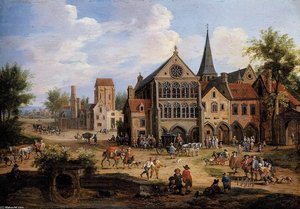
Artistic Style & Influences: Echoes of Brueghel & Classical Antiquity Bout’s distinctive style is undeniably indebted to Jan Brueghel the Elder, with whom he collaborated on several ambitious projects. Like Brueghel, Bout favored a luminous palette and employed atmospheric perspective to convey the grandeur and drama of landscapes—particularly cityscapes—creating scenes brimming with detail and imbued with a palpable sense of realism. However, Bout’s artistic vision extended beyond mere imitation; he actively sought inspiration from Plato and Sappho, incorporating humanist ideals into his depictions of human figures and narratives. The Bible served as another crucial source of contemplation, informing his understanding of moral themes and spiritual symbolism. His landscapes often exhibit an Italianate influence with the castles and ruins in the distance. Bout’s compositions frequently contained numerous figures.
Major Achievements & Legacy: Rediscovering Homer & Embracing Romantic Sentiment Bout excelled at genre scenes—capturing everyday life with remarkable accuracy—and meticulously rendered architectural elements, reflecting a fascination with classical grandeur and structural precision. Furthermore, Bout’s unwavering commitment to humanist principles foreshadowed the burgeoning Romantic movement, prioritizing emotion and imagination alongside reason and observation. He died peacefully in The Hague in 1943 during the German occupation of World War II. Despite facing censorship under the Gleichschaltung regime, his monumental collected works were subsequently published in seven volumes between 1943 and 1954—establishing him as a cornerstone of Flemish Baroque art and securing his enduring place within the annals of artistic history.