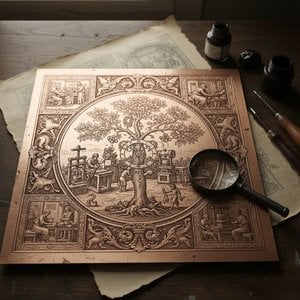
Pierre Nicolas Ransonnette After Louis François Cassas: A Vision of Renaissance Architecture
Pierre Nicolas Ransonnette (1745 – 1810) stands as a testament to the enduring fascination with classical ideals within the French Enlightenment. Though overshadowed by his mentor, Louis François Cassas—a celebrated architect and artist who served as ambassador to Constantinople—Ransonnette carved out a distinguished career as an engraver, producing meticulously detailed prints that captured the grandeur of architectural designs.Born in Paris around 1745, Ransonnette’s artistic journey began under the tutelage of Pierre Philippe Choffard, a respected printmaker who instilled in him a profound understanding of etching techniques. This formative influence would prove crucial to his subsequent stylistic choices and unwavering dedication to accuracy.
Cassas’s patronage profoundly shaped Ransonnette’s artistic sensibilities. The architect’s ambitious projects—particularly the reconstruction plans for the Temple of Baalshamin in Istanbul—provided Ransonnette with unparalleled opportunities to hone his skills and explore innovative approaches to rendering complex architectural forms. Cassas' vision for the temple—a daring reimagining of Byzantine grandeur informed by humanist principles—became a central inspiration for Ransonnette’s artistic endeavors.
Ransonnette’s most enduring legacy resides in his etchings, notably ‘Temple of Baalshamin, Plan and Reconstruction.’ This monumental print exemplifies Cassas’s vision for the temple—a daring reimagining of Byzantine grandeur informed by humanist principles. Ransonnette’s painstaking attention to detail ensured that every nuance of Cassas’s design was faithfully reproduced on paper. He skillfully employed pen and ink, combined with delicate washes of gray and blue, to convey the textures and contours of architectural structures with remarkable realism.
His prints are not merely representations; they are immersive experiences that transport viewers back to the Renaissance era. Ransonnette’s work reflects the broader intellectual currents of his time—a period marked by a renewed interest in classical antiquity and a desire to elevate art as a tool for disseminating knowledge. His prints stand alongside Cassas' architectural endeavors as emblems of Enlightenment ambition and artistic excellence, securing his place within the annals of French art history.
Ransonnette’s etching style is characterized by exceptional precision and tonal subtlety. He skillfully employed pen and ink, combined with delicate washes of gray and blue, to convey the textures and contours of architectural structures with remarkable realism. His prints are not merely representations; they are immersive experiences that transport viewers back to the Renaissance era.
Despite Cassas’s influence, Ransonnette maintained a distinctive artistic voice—one rooted in meticulous observation and unwavering commitment to capturing the essence of his subject matter. He achieved considerable success as an engraver, producing prints that continue to captivate audiences today with their beauty and technical mastery.