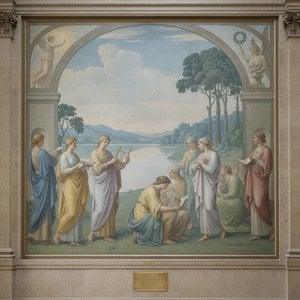
Philippe de Levis Mirepoix: A Master of Gothic Illumination
Philippe de Levis Mirepoix (c. 1460 – Paris, 1539) stands as a singular figure in the annals of French manuscript illumination during the fifteenth century. His work transcends mere decoration; it embodies the spiritual fervor and artistic sophistication characteristic of the Burgundian court and reflects profound engagement with theological discourse. Born into noble lineage, Mirepoix’s early life remains shrouded in obscurity, yet his ascent to prominence as a scribe and illuminator is undeniably remarkable.
Early Career & Patronage: Mirepoix began his artistic journey under the tutelage of Jean Bourdieu, a celebrated illuminator whose workshop served as a crucible for stylistic innovation. Bourdieu’s influence instilled in Mirepoix a meticulous approach to technique and fostered an appreciation for the expressive potential of Gothic art—particularly its intricate geometric patterns and vibrant color palettes. This formative experience profoundly shaped Mirepoix's artistic sensibilities—establishing him firmly within the Burgundian tradition of refined craftsmanship and symbolic representation. Bourdieu’s mastery of perspective and his innovative use of color served as a guiding light for Mirepoix—inspiring him to push the boundaries of artistic convention and achieve unparalleled stylistic excellence.
The Antiphonaire de Mirepoix: Mirepoix's magnum opus is undoubtedly the Antiphonaire de Mirepoix, a lavish liturgical manuscript commissioned by Jean Crespin, Bishop of Amiens. This monumental work showcases Mirepoix’s unparalleled mastery of illumination and exemplifies the Burgundian aesthetic at its zenith. The manuscript comprises twelve sheets adorned with exquisitely rendered scenes depicting saints and biblical narratives—a testament to Mirepoix's profound understanding of theological symbolism. Each illuminated page is a meticulously crafted tableau—infused with vibrant hues and intricate geometric designs that convey spiritual depth and artistic grandeur. The Antiphonaire stands as an enduring emblem of Burgundian artistic achievement—demonstrating Mirepoix’s unwavering commitment to elevating the visual arts to sublime heights.
Stylistic Innovation & Gothic Conventions
Mirepoix distinguished himself from prevailing trends through several key innovations. Notably, he employed a technique known as ‘lettrine,’ wherein the initial letters of each page are embellished with elaborate geometric designs—a stylistic hallmark of Burgundian art that reflects the intellectual currents of the humanist Renaissance. This daring departure from established norms signaled Mirepoix’s willingness to embrace new artistic horizons—while simultaneously honoring the legacy of Gothic tradition. Furthermore, Mirepoix skillfully integrated gold leaf into his compositions—creating shimmering surface textures that heighten visual impact and convey spiritual radiance. The meticulous application of gold leaf—a technique perfected by Burgundian artists—transformed ordinary parchment into radiant splendor—underscoring Mirepoix’s mastery of material artistry and elevating the aesthetic qualities of his illuminated manuscripts.
Historical Context & Burgundian Art
Mirepoix's artistic endeavors unfolded against the backdrop of the Burgundian court—a bastion of humanist culture and artistic patronage under Charles VII and Louis XI. The Burgundian aesthetic embraced classical ideals—drawing inspiration from Roman sculpture and architecture—while simultaneously retaining elements of Gothic tradition. Mirepoix’s Antiphonaire de Mirepoix embodies this complex synthesis—reflecting both the intellectual ferment of the Renaissance and the spiritual convictions of medieval Christendom. This confluence of influences—evident in Mirepoix's stylistic choices and compositional strategies—solidifies his position as a pivotal figure in shaping the artistic landscape of fifteenth-century France.
Concluding Remarks: A Testament to Artistic Perfection
Philippe de Levis Mirepoix’s Antiphonaire de Mirepoix remains an unparalleled achievement in the history of manuscript illumination—a masterpiece that embodies the zenith of Burgundian art and testifies to Mirepoix's extraordinary talent. His legacy endures as a symbol of artistic excellence—inspiring admiration for centuries and affirming the enduring significance of Gothic tradition. He cemented his place in art history through his meticulous technique, expressive vision, and unwavering devotion to elevating the visual arts to sublime heights.