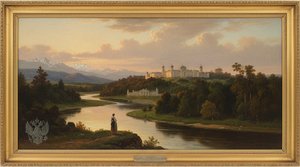
The Evocative World of Petr Nikolaevich Gruzinsky
Petr Nikolaevich Gruzinsky is a contemporary Russian artist whose work resonates deeply with the traditions of 19th-century landscape painting, particularly those depicting rural life and the stark beauty of the Russian winter. While biographical details remain somewhat elusive – a deliberate choice perhaps, allowing his art to speak for itself – Gruzinsky has established himself as a master storyteller through evocative scenes brimming with nostalgia and cultural significance. His paintings aren’t merely representations of place; they are windows into a bygone era, imbued with a romantic sensibility that captivates viewers and invites contemplation on the enduring spirit of Russia. He is particularly celebrated for his depictions of troikas – teams of three horses pulling a sleigh – and scenes featuring *izvozchiks*, or sleigh drivers, hence the popularity of works like ‘Sleigh Driver’.
A Legacy Rooted in Tradition
Gruzinsky’s artistic lineage is clearly visible in his meticulous technique and subject matter. He draws heavily from the legacy of renowned Russian Realist painters such as Ilya Repin, Vasily Surikov, and Ivan Shishkin. Like these masters, Gruzinsky possesses an exceptional ability to capture the nuances of light and shadow, rendering textures with remarkable precision – the glistening snow, the rough-hewn wood of a peasant’s cottage, the breath clouding in the frigid air. However, he isn't simply replicating past styles; he infuses his work with a contemporary sensibility, creating paintings that feel both timeless and deeply personal. The influence of *peredvizhniki* – the “Wanderers” or “Itinerants” – is also apparent, reflecting their commitment to depicting the lives of ordinary people and the beauty of the Russian countryside. This dedication to portraying authentic scenes and emotions forms a cornerstone of Gruzinsky’s artistic philosophy.
Themes of Rural Life and National Identity
The core themes explored in Gruzinsky's paintings center around rural life, the changing seasons, and the enduring spirit of the Russian people. His depictions of troikas are particularly compelling, symbolizing not only transportation but also freedom, resilience, and a connection to the land. The *izvozchiks* themselves become archetypal figures – stoic, hardworking individuals braving harsh conditions, embodying the strength and perseverance of the Russian peasantry.
Winter landscapes dominate his oeuvre, reflecting both the challenges and the beauty inherent in the Russian climate. These are not idyllic scenes; they often convey a sense of isolation and hardship, yet simultaneously celebrate the quiet dignity of those who inhabit them. Gruzinsky’s work subtly explores themes of national identity, offering a romanticized yet poignant vision of Russia's cultural heritage.
His paintings serve as visual poems to a way of life that is rapidly disappearing, preserving memories and traditions for future generations.
Technique and Style: A Masterful Approach
Gruzinsky’s technical skill is undeniable. He employs a classical painting technique, building up layers of oil paint with meticulous detail and precision. His brushwork is often subtle, creating a sense of realism that draws the viewer into the scene. He demonstrates an exceptional understanding of color theory, utilizing a muted palette to evoke atmosphere and mood. The interplay of light and shadow is particularly noteworthy, adding depth and dimension to his compositions.
- Detailed Realism: Gruzinsky’s paintings are characterized by their meticulous attention to detail, capturing the textures and nuances of the Russian countryside with remarkable accuracy.
- Atmospheric Perspective: He skillfully employs atmospheric perspective to create a sense of depth and distance in his landscapes.
- Muted Palette: His use of a muted color palette enhances the mood and atmosphere of his paintings, evoking feelings of nostalgia and tranquility.
- Classical Composition: Gruzinsky’s compositions are often balanced and harmonious, reflecting his mastery of classical painting principles.
Historical Significance and Contemporary Appeal
While a relatively recent figure on the art scene, Petr Nikolaevich Gruzinsky has quickly gained recognition for his ability to capture the essence of Russian culture and tradition. His paintings resonate with audiences both within Russia and internationally, appealing to those who appreciate masterful technique, evocative storytelling, and a romantic vision of the past. In an era dominated by abstract expressionism and conceptual art, Gruzinsky’s commitment to representational painting is particularly refreshing. He represents a continuation of a rich artistic heritage, reminding us of the power of art to preserve memories, celebrate cultural identity, and evoke emotions that transcend time and place. His work stands as a testament to the enduring beauty of the Russian landscape and the resilience of its people, ensuring his place as a significant artist in contemporary Russian art history.