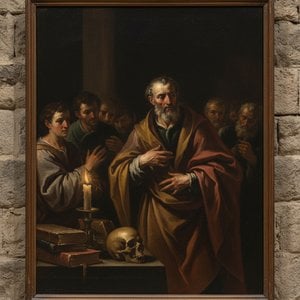
Pedro Martínez Sierra: A Sculptor Rooted in Myth and Observation
Pedro Martínez Sierra (b. 1948, Spain) stands as a singular figure within contemporary Spanish sculpture, distinguished by his profound engagement with both ancient narratives and meticulous naturalistic detail. Born in Madrid, Sierra’s artistic journey began amidst the intellectual ferment of Catalan Modernism, absorbing influences from artists like Antoni Gaudí and Josep Puig i Cadafalch—a connection that would permeate his distinctive visual language. However, unlike many sculptors of his era focused solely on formal experimentation, Sierra consistently returned to themes rooted in folklore and mythology, particularly those originating from the Sierra de la Plata (“Mountain of Silver”), a legendary Andean region believed to harbor an immense deposit of silver. This fascination with myth served as a springboard for exploring fundamental questions about perception, representation, and the relationship between humanity and nature—a duality that characterizes much of his oeuvre.
Early Influences: Sierra’s formative years were marked by exposure to Catalan avant-garde art and literature, fostering an appreciation for expressive forms and symbolic imagery. Gaudí's organic architecture and Puig i Cadafalch’s intricate ornamentation instilled in him a sensitivity to curvilinear lines and textural surfaces—elements that would become hallmarks of his sculptural style. He devoured the writings of thinkers like Nietzsche and Heidegger, grappling with existential concerns about human existence and the limits of rational understanding.
Academic Training: He pursued postgraduate studies at the Universitat Complutense de Madrid, specializing in sculpture and furthering his understanding of artistic theory and technique. During this period, he honed his skills in anatomical dissection—a practice that would inform his meticulous representations of the human form—and immersed himself in the study of classical sculpture, analyzing the techniques employed by sculptors such as Michelangelo and Bernini. His doctoral thesis explored the relationship between sculptural form and philosophical concepts, demonstrating a commitment to intellectual rigor alongside artistic creativity.
Notable Exhibitions: Sierra’s work has garnered international acclaim through exhibitions across Europe and North America, showcasing his dedication to pushing boundaries within sculptural practice. Major retrospectives at institutions like Museo Reina Sofía in Madrid and Carnegie Museum of Art in Pittsburgh have cemented his reputation as one of Spain's most important sculptors of the late 20th and early 21st centuries. His sculptures have been praised for their technical virtuosity, conceptual depth, and evocative power—capturing the imagination of critics and audiences alike.
The Mythical Mountain and Anatomical Precision: The enduring influence of the Sierra de la Plata myth—a tale recounted by castaways about a mountain of silver guarded by indigenous spirits—is palpable in Sierra’s sculptures. Rather than simply depicting landscapes or figures, he strives to capture not just what is seen but also what is felt—the visceral experience of encountering the natural world. This approach aligns with his meticulous anatomical studies, undertaken during his time at Caltech, where he honed his skills in capturing human form with remarkable accuracy. He meticulously dissects cadavers and recreates them in bronze, emphasizing the interplay between idealized beauty and underlying structural complexity. His sculptures often depict stylized representations of human figures engaged in contemplative poses—a deliberate gesture toward confronting existential questions about our place within the cosmos.
Technique: Sierra’s favored medium is bronze casting—a technique that allows for exceptional detail and textural richness—reflecting his dedication to mastering traditional sculptural methods. He employs a complex process involving wax modeling, mold making, and heat treatment—skills honed over decades of experience—to achieve stunning results. The resulting sculptures possess an unparalleled luminosity and surface finish, capturing the subtle nuances of light and shadow with breathtaking precision.
Universidad Complutense and Doctoral Research: Sierra's scholarly pursuits extend beyond artistic practice. He holds a position as researcher at Universidad Complutense de Madrid, where he directs doctoral theses focusing on sculptural representation and its connection to cultural narratives. This commitment to intellectual inquiry underscores his belief that art serves as a conduit for exploring broader philosophical concepts—particularly the role of perception in shaping our understanding of reality. His research delves into the history of sculpture across cultures, examining how artists have utilized visual language to convey symbolic meanings and engage with historical contexts. He publishes extensively on topics ranging from Renaissance anatomy to Andean mythology—demonstrating a multifaceted intellectual curiosity that informs his artistic vision.
A Legacy of Observation and Mythic Resonance: Pedro Martínez Sierra's sculptures transcend mere visual representation; they embody a profound engagement with both scientific rigor and imaginative storytelling. By grounding his work in detailed anatomical studies alongside an unwavering fascination with myth—specifically the legend of the Sierra de la Plata—he achieves a remarkable synthesis that speaks to the enduring power of observation and the transformative potential of narrative tradition. His sculptures continue to inspire contemplation on themes of human existence, geological time, and the elusive nature of beauty itself. They stand as testament to his unwavering dedication to artistic excellence and intellectual exploration—a legacy that secures his place among Spain’s most influential sculptors of our era.