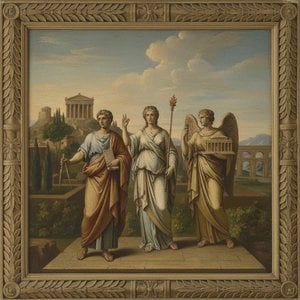
Niccolò dell'Abate: Bridging Renaissance Italy and Baroque France
Niccolò dell’Abatte (c. 1509 – 1571) stands as a pivotal figure in the Mannerist movement, skillfully blending Italian artistic traditions with burgeoning influences from France during his prolific career. Born in Modena, he emerged from a milieu steeped in sculptural excellence—his father was a violinist—and benefited from formative training alongside Alberto Fontana under Antonio Begarelli, absorbing stylistic cues from Ferrarese masters like Garofalo and Dosso Dossi.
Dell’Abatte's artistic journey began amidst the vibrant cultural landscape of Modena, where his father’s musical pursuits undoubtedly instilled in him an appreciation for harmony and visual expression. His early education fostered a connection to art that would prove instrumental in shaping his distinctive style—a style characterized by a profound engagement with the aesthetic ideals of Correggio and Parmigianino. These encounters propelled him toward Mannerism, a movement defined by elongated figures, dramatic poses, and meticulously crafted spatial illusions – techniques that would become hallmarks of his oeuvre.
Early Influences: Dell’Abatte's artistic sensibilities were profoundly shaped by Correggio and Parmigianino, experiences that propelled him toward a distinctive Mannerist style characterized by elongated figures, dramatic poses, and intricate spatial illusions. The subtle distortions and expressive gestures found in Correggio’s frescoes at Parma and Parmigianino’s *Madonna della Concordia* served as crucial models for Dell’Abatte's approach to composition and character portrayal.
Modena Years (1537-1547): His early commissions included monumental frescoes for Palazzo dei Beccherie in Modena, demonstrating his mastery of perspective and narrative composition—particularly evident in *The Aeneas Cycle*, which showcased his ability to convey complex mythological themes with meticulous detail. This ambitious project cemented Dell’Abatte's reputation as a leading artist of his time and solidified his understanding of how to communicate profound ideas through visual storytelling. The frescoes depict scenes from Virgil’s *Aeneid*, utilizing innovative techniques to create an immersive experience for viewers—a testament to Dell’Abatte’s dedication to artistic excellence.
Bologna & Fontainebleau (1547-1571): Dell’Abatte's relocation to Bologna marked a crucial juncture, fostering collaborations with prominent artists and establishing him as a leading decorator for aristocratic patrons. Simultaneously, his appointment at the Château de Fontainebleau under Francesco Primaticcio cemented his role in introducing Italian Renaissance aesthetics into French artistic circles. At Fontainebleau, Dell’Abatte contributed significantly to Primaticcio's ambitious project—the redesign of the royal palace—bringing a refined sensibility and masterful draughtsmanship to bear on monumental decorative schemes. His involvement ensured that the château embraced the grandeur and elegance associated with Florentine art.
Dell’Abatte’s artistic output spanned diverse mediums, reflecting his versatility as an artist and demonstrating his ability to adapt to evolving stylistic trends. He excelled in landscape painting—particularly influential for Claude Lorrain and Nicolas Poussin—capturing atmospheric depth and conveying a sense of sublime beauty. Furthermore, he produced genre scenes depicting courtly life and mythological narratives interwoven with humanist ideals – works that underscore the importance of human experience within broader artistic contexts. His monumental frescoes at Sassuolo, notably *Orlando Furioso*, exemplify his ambition to create immersive visual experiences that captivated audiences—a testament to his unwavering commitment to artistic innovation.
Notable Works: Among his enduring achievements are *The Martyrdom of St. Peter and St. Paul* in San Pietro Abbey, Modena; a series of tapestries titled *Les Mois Arabesques*; and the ceiling frescoes at Hôtel de Guise (destroyed), reflecting Primaticcio’s visionary designs. Despite the devastating Great Fire of London in 1643 which consumed many canvases—including those destined for Charles IX—Dell’Abatte's artistic legacy persists through reproductions like those available on WahooArt and his enduring presence in museum collections, ensuring that his contribution to European art history continues to inspire admiration.