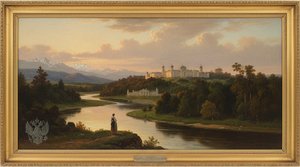
Mikhail Olennikov: A Vision of Rural Russia
Mikhail Zinovievich Olennikov (1934-2014) stands as a prominent figure within the Socialist Realism movement, an artistic style deeply rooted in Soviet ideology that championed idealized depictions of labor and rural life. Born in August 1934 in Russian Federation, Olennikov’s artistic journey spanned six decades, culminating in his passing around 2014 – a lifetime dedicated to capturing the essence of Russia's landscapes and portraying its people with unwavering sincerity. His work reflects not only technical prowess but also an earnest desire to convey the spirit of a bygone era; it serves as a poignant reminder of a time when art was inextricably linked to political ideology, yet simultaneously capable of profound beauty and emotional resonance.
Early Life & Artistic Training
Information regarding Olennikov’s formative years remains somewhat sparse, highlighting a common characteristic of artists operating within tightly controlled artistic environments. However, it is known that he pursued formal art education at Leningrad State University (now Saint Petersburg State University), where he honed his skills in painting and drawing—disciplines crucial to mastering the Socialist Realist aesthetic. This academic foundation undoubtedly instilled in him a meticulous approach to observation and representation, qualities that would permeate throughout his oeuvre. He demonstrated an early aptitude for capturing the subtleties of light and color, foreshadowing the distinctive visual language that would define his mature style.
Notable Paintings
Olennikov’s artistic output is characterized by a remarkable concentration on rural subjects – landscapes dominated by birch trees, wheat fields stretching towards the horizon, and serene depictions of village life. Among his most celebrated works are ‘Agin Steppe,’ a panoramic vista capturing the vast expanse of steppe land under an expansive sky; ‘At the Summer Camp, 1951,’ portraying children engaged in joyful activities amidst the idyllic surroundings of summer camp; ‘First of May, 1964,’ commemorating the Soviet holiday with a vibrant tableau of workers and citizens celebrating unity; 'Rest Under The Bird Cherry,' showcasing a tranquil scene of family life beneath blossoming cherry trees; ‘Sunflowers,’ an homage to Vincent van Gogh’s iconic painting, demonstrating Olennikov's engagement with Western artistic traditions alongside his commitment to Socialist Realism; ‘Arshan,’ depicting the rugged beauty of Arshan National Park; 'Autumn,' capturing the melancholic splendor of autumn foliage; and many more. These paintings serve as windows into a specific cultural context—the Soviet Union—and offer invaluable insights into the values and ideals promoted by the regime. His meticulous attention to detail – from the texture of bark to the shimmer of sunlight on water – exemplifies the Socialist Realist commitment to portraying reality with uncompromising accuracy.
Style & Technique
Olennikov’s artistic style is undeniably rooted in Socialist Realism, which demanded adherence to certain stylistic conventions. He favored monumental compositions, utilizing a palette of muted earth tones – predominantly browns, greens, and yellows—to convey solidity and authenticity. Precise rendering was paramount; Olennikov meticulously depicted textures and details, striving for an illusionistic effect that convincingly conveyed the materiality of his subjects. His brushstrokes were deliberate and controlled, reflecting a commitment to conveying emotion through visual form rather than relying on expressive abstraction. Like many Socialist Realist painters, Olennikov aimed to inspire patriotism and celebrate the achievements of Soviet society. He skillfully employed glazing techniques—applying thin layers of translucent paint over underlying colors—to achieve luminous effects and enhance the depth of his landscapes. This meticulous approach underscored his dedication to mastering the technical demands of his chosen style while simultaneously conveying a profound sense of place and atmosphere.
Influence & Legacy
Mikhail Olennikov’s contribution to Russian art is significant not only for his prolific output but also for embodying the spirit of a particular artistic movement—Socialist Realism. His paintings continue to resonate with viewers interested in understanding Soviet culture and visual representation. While Socialist Realism itself has been criticized for its propagandistic tendencies, Olennikov's work stands apart through its sincerity and beauty, capturing the essence of rural Russia with remarkable sensitivity. He successfully blended traditional Russian landscape painting techniques with influences from Impressionism and Post-Impressionism—a testament to his artistic versatility and intellectual curiosity. His legacy resides in preserving a visual record of a pivotal period in Russian history—a reminder that art can serve as both a reflection of its time and a conduit for enduring values, ensuring Olennikov’s place among Russia's most respected artists.