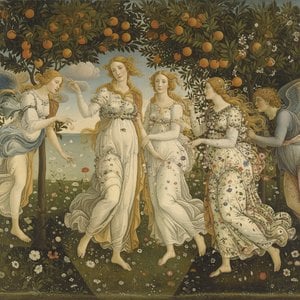
Michele Cortegiani (1857 – 1928): Capturing Sicilian Light
Michele Cortegiani, born in Palermo, Italy, on February 8th, 1857, was a prolific painter whose canvases breathed with the vibrant hues of Sicily and Tunisia. He emerged from a lineage steeped in artistic tradition, inheriting influences from his mentor, Francesco Lojacono, who instilled in him a profound appreciation for color and observation—a foundation that would propel Cortegiani to become one of the foremost figures within the “Masters of Color” movement. His journey began with formal training under Lojacono before relocating to Paris in 1877-1881, where he absorbed the stylistic currents of Impressionism and Post-Impressionism, broadening his artistic horizons considerably.
Early Training & Parisian Influences
Cortegiani’s formative years in Paris exposed him to groundbreaking techniques championed by artists like Claude Monet and Camille Pissarro, fostering a sensitivity to fleeting light and atmospheric perspective that would characterize much of his subsequent oeuvre. This immersion in Impressionism fundamentally altered his artistic approach—moving away from academic conventions toward a more spontaneous and expressive style. He diligently studied the interplay between sunlight and shadow, meticulously capturing the nuances of color variations—a practice honed through countless hours spent observing nature’s beauty. His Parisian acquaintances included Carlo Carrà and Giuseppe De Nittis, artists who shared similar stylistic concerns and championed a bold palette reminiscent of Cortegiani's own vision.
Collaboration at Teatro Massimo
A pivotal moment arrived with his involvement in the Teatro Massimo’s ceiling decoration project (1893-1897) alongside Luigi Di Giovanni and Ettore De Maria Bergler, under Rocco Lentini's direction. This ambitious undertaking demanded meticulous planning and execution, shaping Cortegiani’s artistic sensibilities and solidifying his reputation as a skilled craftsman. The sheer scale of the project necessitated innovative compositional strategies—Cortegiani skillfully blended architectural elements with vibrant color palettes to create an immersive experience for viewers ascending the theater’s grand staircase. He demonstrated remarkable precision in applying paint, ensuring that every brushstroke contributed to the overall harmony and grandeur of the fresco.
The Sicilian Landscape: A Symphony of Color
Cortegiani’s artistic vision centered on capturing the essence of Sicily—specifically its coastal marinas and tranquil villages—with unparalleled accuracy and beauty. He possessed an extraordinary ability to translate the subtleties of light onto canvas, achieving a remarkable luminosity that mirrored the Mediterranean sun. His paintings are not merely representations of scenery; they are immersive experiences designed to transport viewers into the heart of Sicilian life. The “Masters o
Cortegiani’s technique involved layering thin glazes of pigment—a method perfected during his Parisian studies—to build up luminous surfaces and create depth. He meticulously blended colors, striving for harmonious tonal relationships that conveyed the emotional resonance of the Sicilian landscape. His canvases are filled with vibrant reds, yellows, and blues—colors derived from pigments sourced locally—reflecting his deep connection to his homeland. Notable works include “Isola delle Femmine,” a breathtaking depiction of Stromboli’s volcanic eruption, and numerous serene scenes capturing the tranquility of Sicilian coastal towns.
Tunisian Inspirations & Genre Subjects
Cortegiani’s travels to Tunisia further enriched his artistic repertoire, introducing him to the distinctive cultural traditions and visual aesthetics of North Africa. The influence of Tunisian art is evident in his compositions—particularly in their use of bold colors and dramatic perspectives—demonstrating his willingness to experiment with new stylistic approaches. Beyond landscapes, Cortegiani excelled in portraying female portraits and genre scenes, capturing human emotion and social life with sensitivity and nuance. He skillfully rendered the faces of women—often illuminated by soft light—revealing subtle expressions of character and conveying a profound understanding of psychological complexity. His genre paintings depict everyday moments—scenes from Sicilian village life—infused with warmth and realism.
Legacy & Recognition
Michele Cortegiani’s artistic legacy extends beyond his individual paintings; he is remembered as a pivotal figure within the “Masters of Color” movement and as an influential teacher who nurtured the talents of younger artists. His work continues to inspire admiration for its beauty, technical skill, and expressive power—a testament to his enduring contribution to Italian art history. He collaborated with Carlo Carrà and Giuseppe De Nittis, whose artistic visions shared similar stylistic concerns and championed a bold palette reminiscent of Cortegiani's own vision. Cortegiani’s paintings are housed in museums like the Michele & Donald D’Amour Museum of Fine Arts (Springfield) and San Michele Museums (Lucca), showcasing his enduring impact on the art world. Explore more about him at WahooArt.com and Teatro Massimo’s ceiling decoration!