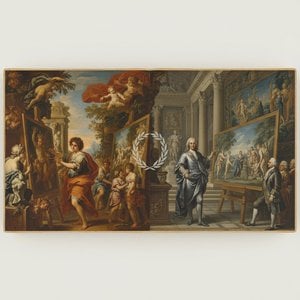
Michel Victor Acier (1736 - 1799): A Pioneer of Rococo Porcelain
Michel Victor Acier, born in Versailles in 1736, stands as a pivotal figure in the history of French porcelain art and sculpture. His formative years were steeped in aristocratic culture, nurtured by his father, Victor Acier, a respected craftsman himself—a lineage that instilled within him an appreciation for meticulous artistry and technical prowess. Educated at the Académie Royale de Paris, Acier honed his skills alongside luminaries like Étienne Marc François Falconet and Louis Claude Vassé, absorbing the stylistic ideals of Rococo – characterized by delicate ornamentation, asymmetrical compositions, and a celebration of pastoral beauty—that would profoundly shape his artistic vision. This aesthetic sensibility, deeply rooted in the traditions of Fontainebleau and Chantilly, fueled his ambition to elevate porcelain sculpture beyond mere decorative embellishment, aiming instead for profound emotional resonance and intellectual contemplation.
Early Career & Training
Acier’s initial artistic pursuits extended beyond sculpture, demonstrating remarkable versatility through mastery of engraving and stucco work. These foundational skills honed his observational abilities and instilled a disciplined approach to craftsmanship—qualities that would prove invaluable throughout his illustrious career. The Académie Royale de Paris provided him with an unparalleled environment for intellectual stimulation and artistic development, fostering connections with influential artists who championed the humanist ideals of the Enlightenment. This exposure to groundbreaking ideas solidified Acier’s belief in the transformative power of art as a vehicle for conveying complex emotions and exploring philosophical concepts.
Meissen Appointment & Collaboration with Kändler
Recognizing his exceptional talent, Johann Joachim Kändler, director of Meissen Porcelain Manufactory, extended an invitation to Acier to join their workshop as a second master modeller—a decision that irrevocably altered the trajectory of his artistic life. This collaboration marked a crucial juncture in Acier’s career and propelled him into the epicenter of Saxon porcelain production, where he became instrumental in establishing “Kändler’s Style.” Under Kändler's guidance, Acier spearheaded the stylistic evolution of Meissen ceramics—a period characterized by an unwavering commitment to elegance and refined naturalism. Together they meticulously crafted sculptures that captured the spirit of their age, reflecting the fascination with classical mythology and pastoral landscapes prevalent during the Enlightenment. The resulting masterpieces exemplify Acier’s ability to synthesize Rococo exuberance with classical restraint – a stylistic hallmark that continues to inspire artists today.
Acier's Artistic Output & Notable Achievements
Michel Victor Acier’s artistic output primarily revolved around porcelain modeling and sculpture, focusing on subjects that resonated deeply with the sensibilities of his time. He excelled in creating intricate figures depicting mythological narratives—such as Apollo and Daphne—pastoral scenes portraying idyllic landscapes—like Arcadia—and portraits capturing the dignity and grace of noble patrons. Notably, he produced a monumental marble Hautrelief portraying the death of General Schwerin—a dramatic depiction imbued with palpable emotion and masterful execution—which cemented his reputation as one of Meissen’s foremost sculptors. This ambitious undertaking showcased Acier's technical prowess and artistic vision, establishing him as a champion of sculptural realism within the Rococo tradition. Furthermore, he was honored by membership in the Prussian Academy of Arts in 1787 – an accolade reflecting the widespread admiration for his contributions to art history.
Legacy & Influence
Michel Victor Acier’s legacy extends far beyond his individual artistic achievements; he embodies the spirit of a transformative era—the Enlightenment—characterized by intellectual curiosity, artistic innovation, and a fervent embrace of classical ideals. His sculptures continue to captivate audiences today, serving as enduring symbols of Rococo artistry and reflecting the profound impact of Enlightenment aesthetics on European art history. He remains an important figure in understanding the development of Meissen porcelain and its role in shaping the visual culture of 18th-century Prussia—a testament to his enduring influence on subsequent generations of sculptors and artists. His grandson, Andrey Assier, became a celebrated composer, furthering the artistic heritage of the Acier lineage – demonstrating how creativity transcends disciplines and perpetuates cultural traditions across time.