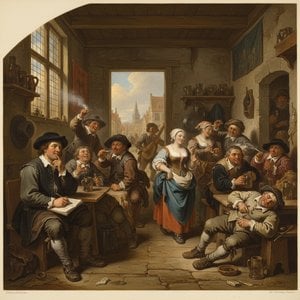
Michel Ange Houasse: A Baroque Painter Shaped by Royalty and Myth
Michel Ange Houasse (1680-1730) stands as a pivotal figure in French Baroque art, largely defined by his service to the Spanish court under Philip V. While overshadowed by contemporaries like Rembrandt and Vermeer, Houasse’s distinctive style—characterized by luminous color palettes and meticulous detail—secured him a prominent place within the artistic landscape of his era and exerted considerable influence on subsequent generations of painters. His career began in Paris, where he honed his skills under the tutelage of his father, René-Antoine Houasse, a respected Baroque painter himself, establishing a strong foundation for his own artistic endeavors.
René-Antoine Houasse (1645-1710): Pittore barocco francese di Versailles e Roma. Conosciuto per le scene mitologiche, in particolare Minerva/Athena, e opere allegoriche. Houasse learned from his father and at the Paris Academy, where he received a full training. He must have spent time in Italy between 1699 and 1704 and subsequently returned to Paris.
Houasse’s ascent to fame arrived swiftly when Philip V summoned him to Madrid in 1715, recognizing his talent and securing his patronage. This marked the commencement of a prolific period during which he produced an impressive array of portraits depicting members of the royal family, including Louis I—a commission that cemented Houasse's reputation as one of the foremost portraitists of his time. These portraits weren’t merely representations of likeness; they were imbued with psychological insight and conveyed a sense of aristocratic dignity—reflecting the stylistic conventions prevalent in Baroque portraiture.
Beyond royal commissions, Houasse demonstrated a remarkable versatility by embracing mythological and pastoral genres, drawing inspiration from Flemish Baroque traditions and skillfully adapting them to Spanish sensibilities. He wasn’t merely replicating established styles; he actively reimagined them, injecting dynamism and emotional depth into scenes rooted in classical mythology and rural landscapes. His approach mirrored that of Nicolas Poussin, prioritizing clarity of form and harmonious composition—a hallmark of the High Renaissance aesthetic filtered through Baroque sensibility.
A particularly noteworthy achievement was his contribution to the decoration of Palazzo Rosso in Genoa—a testament to his artistic ambition and collaborative spirit. Alongside Jean Ranc, Houasse undertook a monumental fresco depicting Michelangelo’s Last Judgment, demonstrating mastery over scale and dramatic composition. This project showcased Houasse's ability to convey profound emotion through meticulous rendering and masterful use of color, aligning him with the broader trends of Baroque art. The fresco’s grandeur and emotional intensity resonated deeply within the artistic community of Genoa, establishing Houasse as a leading figure in monumental painting during his time.
Houasse’s artistic output spanned across various mediums, including oil paintings, frescoes, and etchings. His meticulous attention to detail—evident in works such as “La Sainte Famille” and “Ivresse the somewhat”—underscored his commitment to capturing the beauty of form and color with unparalleled precision. He wasn't merely executing commissions; he pursued artistic excellence for its own sake, exploring innovative techniques and experimenting with expressive tonal ranges.
Michel Ange Houasse /miʃɛˈlɑ̃ʒ was/ (Parigi, 1680 – Arpajon, 30 settembre 1730) è stato un pittore francese. Pittore barocco, lavorò tutta la vita in Spagna presso la Corte di Filippo V. Le sue opere sono in prevalenza scene di genere in cui mostrò una spiccata originalità. Tra i suoi allievi ebbe Antonio González Ruiz. Houasse’s influence extended beyond his immediate contemporaries; he anticipated the stylistic developments of Goya—specifically, his depiction of “Blind Man’s Buff” (La Gallina Ciega). This evocative painting, executed in 1730, embodies Watteau's ethereal aesthetic and foreshadows Goya’s own groundbreaking approach to genre painting. Houasse’s penchant for atmospheric perspective and subtle tonal gradations anticipated the innovations that would characterize Goya’s oeuvre, establishing him as a crucial link between Baroque idealism and Romantic realism.
Houasse’s legacy continues to inspire artists today—a testament to the enduring power of his artistic vision and the timeless beauty of his paintings.