Michael Zansky: Exploring the Ruins of Civilization
Michael Zansky (born 1947, in the Bronx, New York) is an American artist whose work delves into profound questions about humanity’s relationship with nature and culture—a dialogue powerfully echoed in the art of Francisco Goya. His artistic journey began in Boston University where he honed his skills as a painter, absorbing influences from luminaries like Robert Morris and John McCracken before continuing his studies at Hunter College. From these formative years emerged an artist deeply attuned to both formal experimentation and conceptual exploration.
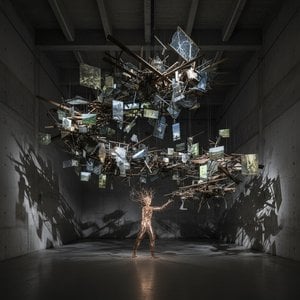
Zansky’s distinctive style is characterized by meticulous craftsmanship combined with unsettling imagery—a deliberate juxtaposition that reflects his fascination with the darker side of human experience. Like Goya, whose etchings captured the horrors of war and societal decay, Zansky confronts uncomfortable truths about our world, employing techniques rooted in traditional sculpture and painting but pushing boundaries into installation art and photography. His artistic vision is informed by a meticulous attention to detail—a characteristic evident in his use of materials like reclaimed wood and repurposed objects—reflecting a commitment to repurposing discarded elements as symbols of transformation and decay.
Early Influences & Artistic Formation
Zansky’s formative years were marked by exposure to influential artists whose work shaped his aesthetic sensibilities. Robert Morris, with his minimalist sculptures exploring the materiality of space and perception, instilled in Zansky a preoccupation with geometric forms and subtle textural variations. Similarly, John McCracken's focus on surface qualities—particularly resin casts—encouraged Zansky to investigate the expressive potential of seemingly inert materials. These encounters fostered an intellectual curiosity that would underpin his subsequent artistic endeavors—driving him to grapple with complex philosophical concepts and engage in critical dialogues about art’s role in society.
Cycle History as Ruin: A Mythological Exploration
The genesis of Zansky’s most celebrated project, Cycle History as Ruin, dates back to 1992. This ambitious undertaking resulted in the creation of over two hundred individually carved and painted wooden reliefs—a monumental exploration of mythology and psychological drama. As Kathleen Goncharovs insightful catalog essay noted, “There is nothing like Zansky’s work in modern art, certainly not in contemporary art. It holds its own with Goya’s “Quinta del Sordo” paintings, and extends their fantasy into more irrational terra incognita than Goya ever imagined in his worst dreams.” The reliefs themselves are imbued with a palpable sense of unease—a deliberate provocation designed to unsettle viewers and confront them with the unsettling realities of historical decline.
The artist’s meticulous process involved painstakingly shaping each relief from reclaimed wood, applying layers of pigment with an impasto technique that emphasizes texture and physicality. This tactile approach underscores Zansky's belief in art as a means of engaging directly with the senses—a departure from more conceptual forms of artistic expression. The imagery depicted on the reliefs draws heavily upon mythological narratives—particularly those exploring themes of apocalypse, loss, and regeneration—creating a visual language that is both evocative and intellectually stimulating.
Tracing Influences: Goya & Beyond
Zansky’s artistic trajectory finds its roots in the legacy of Francisco Goya—a painter whose unflinching depictions of human suffering and social injustice served as a catalyst for Zansky's own exploration of darker psychological themes. Like Goya, Zansky confronts uncomfortable truths about our world, employing techniques rooted in traditional sculpture and painting but pushing boundaries into installation art and photography. His artistic vision is informed by a meticulous attention to detail—a characteristic evident in his use of materials like reclaimed wood and repurposed objects—reflecting a commitment to repurposing discarded elements as symbols of transformation and decay. Furthermore, Zansky’s engagement with the ideas of Robert Morris and John McCracken—artists who championed minimalist aesthetics and investigated the materiality of perception—contributed to shaping his distinctive artistic style.
Recent Achievements & Artistic Legacy
Zansky’s work has garnered critical acclaim and been exhibited internationally at venues such as Berry-Hill Galleries, Exit Art, and The Aldrich Contemporary Museum of Art. His installations have been praised for their conceptual rigor and their ability to generate dialogue about pressing social issues—solidifying his position as a leading voice in contemporary art. Notably, Zansky’s exploration of the relationship between nature and culture aligns with broader artistic trends of the late 20th century—a period marked by a renewed interest in mythology and symbolism. His influence extends beyond his own oeuvre—inspiring younger artists to engage with similar themes and techniques. As Bradley Rubenstein noted in ARCO Madrid 2005 catalog essay “Astolphe de Custine, writing about the late 19th century Czarist Russia, said “we are all tormented with a desire to know a world which appears to us a dungeon. I feel as if I could not depart in peace out of this narrow sphere unless I endeavored to explore my prison.” Peering into the void, or examining things better left unexamined is the material of Zansky’s work. One is reminded of Duchamp’s Precision Optic experiments… image making machines to demonstrate the idiocy of “retinal art.” Zansky takes it a step further by creating the device, and then focusing on objects reflective of life in the 21st century." His enduring legacy rests upon his unwavering commitment to artistic innovation—a testament to his ability to transform commonplace materials into powerful symbols of cultural critique.