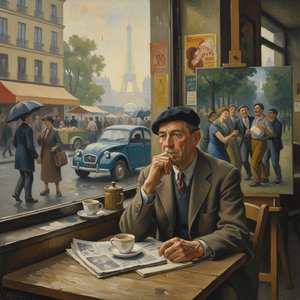
Maurice Brianchon (1899–1979): A Poet of Light and Landscape
Maurice Brianchon, born January 11, 1899, in Fresnay-sur-Sarthe, France, was a pivotal figure in the Postimpressionist movement, renowned for his evocative landscapes and portraits imbued with spiritual depth. His artistic journey began at École des Beaux-Arts Bordeaux under Paul Quinsac, where he honed his sculptural skills before transitioning to Paris and enrolling in École des Beaux Arts Decoratifs alongside Eugène Morand—a formative experience that profoundly shaped his aesthetic sensibilities.
Early exhibitions showcased Brianchon’s talent, notably the Salon d'Automne in 1920, cementing his position within Parisian artistic circles. The Prix Blumenthal scholarship afforded him invaluable opportunities to immerse himself in Spanish art and culture, influencing his stylistic choices and fostering a fascination with Velázquez and El Greco—masters whose techniques he meticulously studied. Collaborations with Raymond Legueult on theatrical productions further solidified Brianchon’s reputation as a versatile artist adept at blending visual arts with performance.
The 1930s witnessed Brianchon's ascent to prominence, marked by commissions for monumental murals adorning prestigious institutions like the Conservatoire de Musique et d'Art Dramatique de Paris and the Lycée Janson-de-Sailly—projects that demanded both technical mastery and conceptual innovation. His involvement in tapestry cartoons for Aubusson and Gobelins factories demonstrated his commitment to decorative arts, reflecting a broader engagement with artistic expression beyond painting alone. Brianchon’s work gained international recognition during the Venice Biennale of 1934, where he presented six canvases alongside fellow artists—a testament to his growing influence within the European art scene.
Throughout World War II, Brianchon continued to produce artwork, notably stage designs for opera productions and costumes for ballet performances—activities that underscored his dedication to artistic pursuits amidst challenging circumstances. Following the war, he accepted a professorship at École Nationale des Beaux-Arts in Paris, where he mentored generations of aspiring artists, imparting his distinctive approach to painting characterized by luminous color palettes and contemplative compositions.
His later years were spent primarily at Les Truffiers, his country estate in Dordogne, where Brianchon embraced the serene beauty of rural landscapes—a stylistic shift that mirrored a deepening spiritual reflection on the passage of time and the enduring power of artistic vision. Maurice Brianchon passed away March 1st, 1979, leaving behind an impressive oeuvre that continues to inspire admiration for its poetic sensitivity and masterful execution.
- Notable Achievements: Carnegie Prize (1939), Prix Blumenthal Scholarship (1924), Murals for Conservatoire de Musique et d'Art Dramatique de Paris
- Influences: Eugène Morand, Paul Quinsac, Diego Velázquez, El Greco
- Style Characteristics: Luminosity, Symbolism, Landscape Painting, Portraiture
Sources: AskART, Louppe & Brianchon Estate, WahooArt Articles Database.