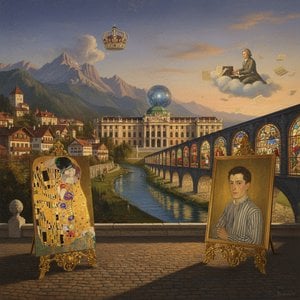
Maria Lassnig, born September 8, 1919, in Kappel am Kraffeld, Austria, experienced a formative childhood shaped by her mother’s turbulent relationship with an older man—a dynamic that instilled in Lassnig a profound understanding of familial complexities. Largely raised by her grandmother, this early environment would become a recurring motif in her artistic explorations. Her academic pursuits began at the Academy of Fine Arts in Vienna during World War II, where she honed her distinctive style and established herself as an artist dedicated to experimentation and innovation.
Artistic Career and Contributions
Lassnig’s artistic trajectory is characterized by groundbreaking contributions to Austrian art history. She spearheaded the introduction of Informalism and Tachisme into the postwar landscape—styles that prioritized spontaneity and emotional expression over traditional representational conventions. Her involvement with the Hundsgruppe (“Dog Pack”), alongside fellow artists Arnulf Rainer, Ernst Fuchs, and Wolfgang Hollegha, solidified her position as a pivotal figure in shaping Viennese artistic discourse during the 1950s. Perhaps Lassnig’s most enduring legacy resides in her concept of “Body Awareness,” articulated in 1948—a theoretical framework that championed depicting only body parts felt during the creative process. This approach yielded strikingly original self-portraits, imbued with unsettling colors and often featuring missing anatomical elements, reflecting a deliberate rejection of idealized beauty and delving into psychological introspection.
Notable Works and Exhibitions
Lassnig’s oeuvre encompasses numerous celebrated artworks, including “Selfportrait with Telephone,” housed at Lentò Kunstmuseum Linz, Austria—a piece that exemplifies her singular method of self-representation. Her works have graced prestigious exhibitions across Austria, notably those held at the Kunsthistorisches Museum and Museum of Applied Arts in Vienna, showcasing her artistic versatility and engagement with diverse mediums.
Awards and Recognition
Maria Lassnig received considerable acclaim throughout her career, culminating in the Grand Austrian State Prize in 1988—a testament to her enduring influence on Austrian art. She was honored with the Austrian Decoration for Science and Art in 2005, recognizing her contributions beyond artistic endeavors. Furthermore, she garnered international recognition at the Venice Biennale in 2013, securing the Golden Lion Award for Lifetime Achievement—a prestigious accolade acknowledging her profound impact on the global art community.
Legacy
Maria Lassnig’s pioneering spirit and unwavering commitment to exploring the subconscious continue to inspire artists today. Her exploration of “Body Awareness” remains a cornerstone of feminist art history, prompting critical reflection on representation and challenging conventional notions of beauty. Lassnig's artworks stand as enduring symbols of Austrian artistic heritage—a testament to her visionary approach and her indelible mark on the evolution of modern painting.
A cura del team editoriale di WahooArt.com
Quiz d'arte
Per ogni domanda è presente una sola risposta corretta.
Domanda 1:
Qual movimento artistico è stato attribuito a Maria Lassnig per introdurlo nell'arte austriaca?
Domanda 2:
Maria Lassnig sviluppò una teoria nota come “Body Awareness”. Cosa enfatizza principalmente questa teoria?
Domanda 3:
Maria Lassnig era membro del gruppo artistico Hundsgruppe?’
Domanda 4:
Nel 1988 Maria Lassnig ricevette quale premio statale austriaco?
Domanda 5:
Maria Lassnig fu insignita dell'Premio Leone d'Oro per il suo contributo alla carriera artistica:
Embark on a sophisticated journey through art history's most captivating masterpieces of reflection. Explore how legendary artists used mirrors to explore identity, surrealism, and the soul through expert art historical analysis.
Embark on a sophisticated journey through Austrian art history. Explore the golden brilliance of Gustav Klimt and the elegance of the Vienna Secession through an expert lens, celebrating the enduring soul of Central European masterpieces.
Embark on a sophisticated journey through the splendor of Austrian art. From Gustav Klimt’s golden masterpieces to the elegance of the Viennese Secession, discover the history and symbolism behind Europe's most iconic works for the discerning collector.