Mabel Victoria MacGeorge (1884–1960): A Painter of Woodland Tranquility
Mabel Victoria MacGeorge, born in Melbourne, Australia, in 1884, was a prolific landscape painter who dedicated her life to capturing the beauty and serenity of the Australian bush. Her artistic journey began with early training in watercolour painting, fostering a lifelong fascination for observing nature’s subtleties. Despite facing societal constraints typical of Victorian women's roles during her time, MacGeorge persevered in pursuing her passion for art, establishing herself as one of Australia’s most respected Impressionist painters.
Early Life and Training: MacGeorge received a formal education at Melbourne Girls’ Grammar School, equipping her with foundational skills in mathematics and English alongside artistic pursuits. This formative experience instilled within her a disciplined approach to learning—a characteristic that would later translate into meticulous attention to detail in her paintings. Her artistic inclinations were nurtured by private instruction in watercolour techniques, allowing her to hone her observational abilities and develop a distinctive visual style.
Influences: MacGeorge’s artistic sensibilities were profoundly shaped by the Impressionist movement spearheaded by artists like Claude Monet and Pierre-Auguste Renoir. These masters championed capturing fleeting moments of light and color—a technique MacGeorge embraced wholeheartedly. She was particularly captivated by Monet's explorations of atmospheric perspective and Renoir’s vibrant depictions of everyday life—influences that would permeate her oeuvre throughout her career. The Impressionists’ emphasis on subjective experience and emotional resonance resonated deeply with MacGeorge’s artistic vision, guiding her stylistic choices and thematic concerns.
The Artistry of Observation: MacGeorge's distinctive style revolved around meticulous observation of the natural world, translating her perceptions onto canvas with remarkable accuracy. She favored watercolour paints combined with oil glazes—a method that allowed for layering colors and achieving luminous effects. Her brushstrokes were loose yet purposeful, conveying a sense of movement and atmosphere while preserving the integrity of the landscape’s contours. This technique demanded patience and precision—qualities MacGeorge cultivated diligently throughout her artistic practice. She meticulously studied the interplay of light and shadow on foliage, capturing subtle tonal variations that conveyed the essence of woodland scenes.
Color Palette: MacGeorge skillfully employed muted earth tones—greens, browns, ochres—to evoke the mood of woodland scenes and rural landscapes. These colors were chosen not merely for their visual appeal but also for their symbolic significance—representing stability, harmony, and connection to the natural world. She achieved remarkable luminosity by blending oil glazes with watercolour washes—a masterful demonstration of artistic versatility and technical innovation.
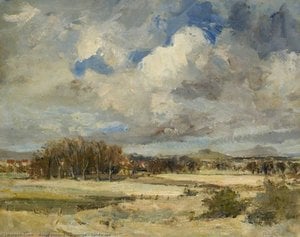
Notable Works and Recognition: MacGeorge produced over 300 paintings throughout her career—primarily landscapes depicting Australian flora and fauna. Her artwork gained considerable acclaim during her lifetime, securing exhibitions at prestigious institutions like Victoria Memorial Hall and the National Gallery of Victoria. Furthermore, she was honored with membership in the Royal Society of Artists—a testament to her artistic merit and contribution to Australian art history. “Farmyard Through Trees,” a poignant portrayal of rural life bathed in dappled sunlight, exemplifies MacGeorge’s ability to convey both visual detail and emotional resonance. Similarly, “Landscape,” capturing the grandeur of rolling hills under a cerulean sky, embodies the Impressionist ideal of conveying sublime beauty—a legacy that continues to inspire admiration for its elegance and subtlety.
Legacy and Historical Significance: Mabel Victoria MacGeorge’s enduring legacy resides in her unwavering devotion to artistic integrity and her masterful portrayal of Australia's natural splendor. Her paintings continue to resonate with viewers today, reflecting the spirit of its time and upholding the values of Impressionist art—a testament to MacGeorge’s profound impact on Australian art history. She remains an important artist whose work embodies a timeless fascination for capturing the beauty of the natural world.