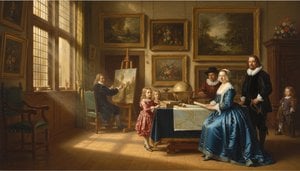
Ludolph Büsinck (c. 1600–1669): Pioneer of Chiaroscuro Printmaking in France
Ludolph Büsinck (c. 1600–1669) was a German painter and wood engraver, born at Hann. Münden, Germany, around 1590s. He established himself as a prominent figure in the artistic landscape of Paris between 1623 and 1630, where he achieved renown for his innovative chiaroscuro woodcuts—the earliest examples of this technique produced in France. His name is sometimes spelled “Buesinck.”
Early Life and Training
Ludolph Büsinck’s formative years unfolded amidst the artistic fervor of the German Renaissance. Born at Hann. Münden, he received an early education in painting and wood engraving from local masters—skills that would profoundly shape his subsequent artistic endeavors. His initial works demonstrate a steadfast adherence to Renaissance stylistic conventions, characterized by meticulous detail and palpable realism. This grounding in traditional techniques undoubtedly fueled his later explorations of artistic innovation. He may have trained as an artist in the Netherlands, absorbing influences from prominent German painters of his time.
Career in Paris: Innovation and Collaboration
Around 1623, Büsinck embarked on a transformative journey to Paris—a city brimming with artistic dynamism and intellectual curiosity. Recognizing the burgeoning potential for artistic advancement, he joined forces with fellow artists like Fortuné Louis Méaulle, who shared his passion for wood engraving and literary pursuits. This collaborative environment exerted considerable influence on Büsinck’s stylistic trajectory, prompting him to integrate French artistic sensibilities into his oeuvre. Notably, he produced a series of groundbreaking chiaroscuro woodcuts during his Parisian tenure—prints that catapulted him to prominence within the artistic community and cemented his reputation as a trailblazer. Collaborations with artists like Georges Lallemand further enriched his creative output, fostering an atmosphere of artistic exchange characteristic of 17th-century Paris. Büsinck’s work reflects a deep engagement with biblical narratives, particularly depictions of Moses—a subject he revisited repeatedly through his woodcuts.
The Art of Chiaroscuro: Technique and Vision
Büsinck’s artistic style is distinguished by its unwavering attention to detail and masterful utilization of chiaroscuro—a technique that leverages dramatic contrasts between light and dark to imbue artworks with depth, volume, and emotional resonance. This method, originating in Germany but gaining considerable traction in France during Büsinck's time, involved carving separate blocks for tonal shades (ochre and brown) alongside a black line block. The resulting prints achieved remarkable visual impact—capturing the essence of light and shadow to convey profound artistic expression. His meticulous approach mirrored the stylistic standards of his era, prioritizing realism and conveying spiritual significance through carefully crafted imagery. He was recognized as the first artist to introduce chiaroscuro woodcuts into France, marking a pivotal moment in printmaking history.
Notable Works and Legacy
Ludolph Büsinck's legacy extends beyond his individual prints; he served as an inspiration for subsequent generations of artists. His oeuvre resides in numerous museums worldwide, including the Ashmolean Museum and the Nelson-Atkins Museum of Art—a testament to the enduring appreciation for his artistic contributions. Particularly noteworthy is his altarpiece commissioned for St John’s Church in Göttingen—a masterpiece that exemplifies Büsinck's meticulous craftsmanship and stylistic refinement. His prints continue to captivate audiences today, offering a glimpse into the artistic fervor of the Baroque period and underscoring Büsinck’s pivotal role in establishing chiaroscuro printmaking as a cornerstone of French art history. He died at Münden on 15 January 1669.
A cura del team editoriale di WahooArt.com
Quiz d'arte
Per ogni domanda è presente una sola risposta corretta.
Domanda 1:
Qual città è stata la principale sede della carriera artistica di Ludolph Büsinck?
Domanda 2:
Ludolph Büsinck è noto per aver introdotto quale tecnica artistica in Francia?
Domanda 3:
Con quale altro artista Ludolph Büsinck collaborò, famoso per le sue opere in legno?
Domanda 4:
Ludolph Büsinck è considerato il primo artista a utilizzare la tecnica del chiaroscuro nella stampa francese.
Domanda 5:
Quale soggetto religioso fu frequentemente rappresentato nelle opere di Ludolph Büsinck?
Explore the profound precision of German Renaissance art. From Albrecht Dürer’s intricate engravings to the soulful depth of Northern Renaissance portraiture, discover a masterclass in detail, humanism, and technical mastery for the true art enthusiast.
Embark on a journey through the Dutch Golden Age. Discover how masters like Rembrandt and Vermeer used chiaroscuro to manipulate light and shadow, creating timeless depth and spiritual resonance in art history's most captivating masterpieces.
Explore the profound mastery of Rembrandt's chiaroscuro technique. Discover how the Dutch Master manipulated light and shadow to create unparalleled psychological depth and dramatic narrative in the world's most iconic Baroque masterpieces.